
Mushrooms Growing in Lawn? Causes, Safe Removal, Prevention
Mushrooms in your turf aren’t a curse—they’re a clue. We’ll show you what they mean, how to get rid of them quickly, and how to stop the comeback.
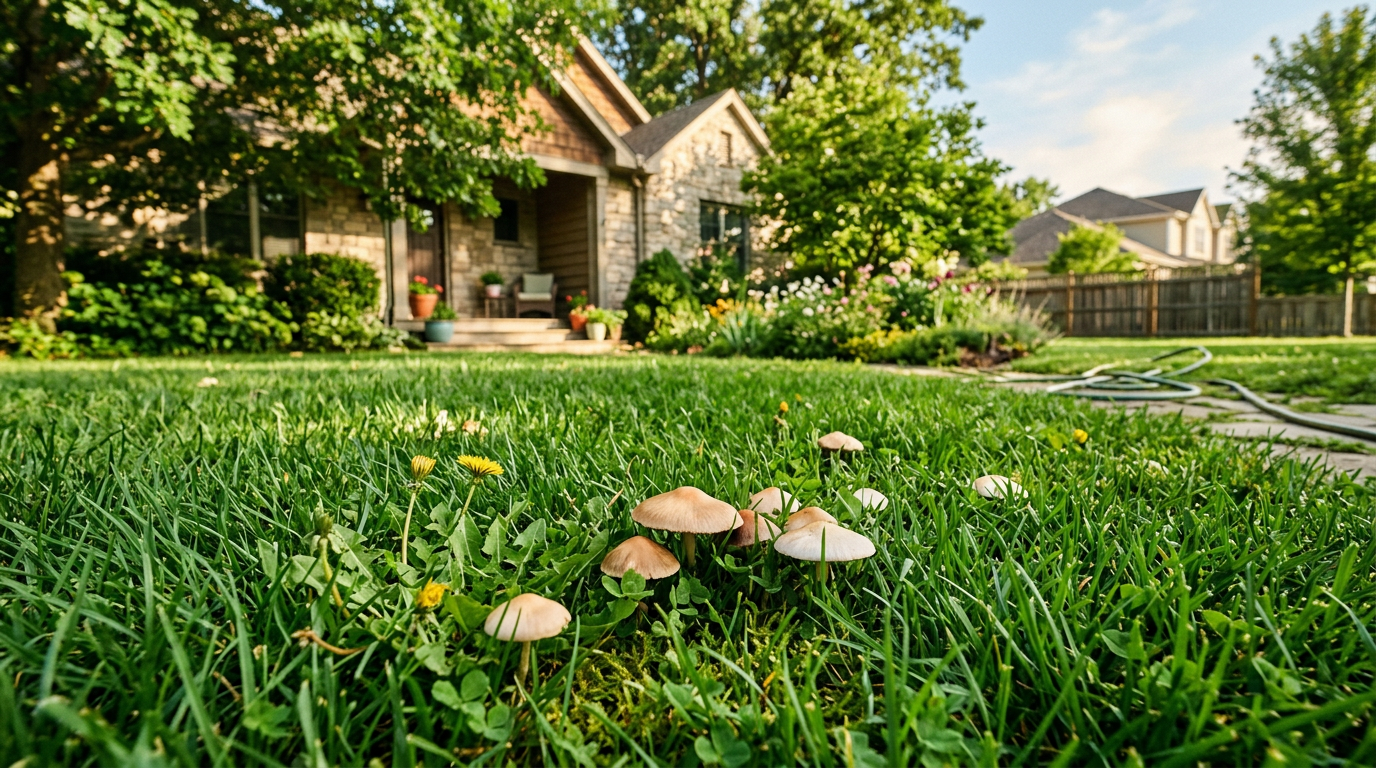
Why mushrooms pop up in your lawn
If you’ve got mushrooms, your soil is wet enough and there’s something organic decomposing under or in your turf—thatch, buried wood, old roots, even dog waste. Fungi thread-like hyphae are already in the soil; mushrooms are just the fruiting bodies. Rain + shade + organic matter = mushrooms. They’re a symptom, not the disease.
We see them after big storms, during cool, humid stretches, and over irrigation zones that run too long.
Are lawn mushrooms bad?
Mostly no. They don’t “infect” grass and often signal good soil biology. The risks: some species can be toxic if eaten (pets/kids), and clusters like fairy rings can create hydrophobic soil that dries grass in arcs. If you’ve got mysterious brown circles, check our Lawn fungus identification: pictures + fixes.
Quick removal (what to do today)
- Hand-pick or twist off caps, then bag and trash. Don’t mulch them with the mower; you’ll just fling spores.
- Rake up thatch/leaf litter that’s feeding them.
- Water less this week. Let the top 1–2 inches of soil dry between irrigations.
- Keep pets from snacking on unknown mushrooms. When in doubt, remove.
Pro move: a cheap rain gauge ($12) tells you if storms already gave your lawn its weekly inch.
Fix the conditions so they don’t return
We’ve beaten recurring mushrooms in our test lawn by tackling moisture + food source. Here’s the fast, realistic plan.
- Water smarter
- Target: about 1 inch per week total (including rain). Deep, infrequent watering only.
- If zones stay wet, shorten runtime or install a moisture manager like Hydretain Liquid Soil Moisture Manager (~$29/qt). It helps the soil hold water longer so you can run irrigation less.
- Improve drainage and oxygen
- Core aerate compacted areas in spring or fall. Rent a core aerator (~$69/day) or use the Yard Butler Lawn Coring Aerator (~$39) for small spaces. Aeration reduces waterlogging and speeds thatch decay.
- Reduce thatch
- Dethatch matted lawns (thatch > 0.5 inch). Sun Joe AJ801E Electric Dethatcher/Scarifier is a solid homeowner buy (~$139). Manual option: Ames/True Temper Thatch Rake (~$39). We’ve pulled bucket-loads of brown fluff—mushrooms lost their buffet.
- Remove buried organic junk
- Mushrooms often trace a line where an old stump/root was. Probe and dig out wood chunks where practical. For shallow, woody spots, topdress and reseed instead of fighting mushrooms for months.
- Nudge decomposition
- A light, quick-release nitrogen app helps microbes finish the job. Use 0.25–0.5 lb N/1,000 sq ft. Scotts Turf Builder UltraFeed (~$37/20 lb) or Milorganite (~$15/32 lb bag) are easy options. Don’t overdo it in heat.
- Increase sun/airflow
- Prune low branches to get more light and breeze on chronically damp turf. Mushrooms hate drying cycles.
If you’re also seeing off-pattern damage—chewed roots or spongy turf—rule out grubs with our How to Get Rid of Grubs in Lawn Naturally and White Grubs in Soil Identification.
What not to do
- Don’t blanket-spray fungicides. Most don’t touch the underlying mycelium or the buried food source and aren’t worth the cost.
- Skip homebrew vinegar/salt/bleach. You’ll burn grass, not fix mushrooms.
- Don’t water daily “a little.” That keeps the surface wet and mushrooms happy.
If you’ve got actual lawn disease (brown patch, dollar spot, rust) alongside mushrooms, ID it first: Lawn fungus identification: pictures + fixes or see seasonal turf issues in Brown Patches in Lawn After Winter.
Numbers you should know
- Lawns generally need about 1 inch of water per week, total. Many systems overwater by 20–50% due to poor scheduling and evaporation (EPA WaterSense: https://www.epa.gov/watersense/outdoor-water-use).
- Mushrooms often fade within 1–3 days once surfaces dry (University of Minnesota Extension: https://extension.umn.edu/plant-diseases/lawn-mushrooms-and-fairy-rings). If they persist, you’ve still got excess moisture or a big food source underneath.
Our simple, field-tested weekend plan
- Pick and bag today’s mushrooms (10 minutes).
- Rake and remove thatch/debris (20–40 minutes).
- Aerate compacted areas (1–2 hours; rental ~$69/day).
- Dethatch if layer > 0.5 inch with Sun Joe AJ801E (~$139) or a thatch rake (~$39).
- Water only to reach 1 inch/week. Add a $12 rain gauge.
- Light nitrogen (0.25–0.5 lb N/1,000 sq ft) to accelerate breakdown.
- Revisit shade and buried wood—and fix what you can.
Stick to that, and the “pop-up mushroom show” stops being a thing. If you start seeing odd holes overnight instead, check Tiny Holes in Lawn at Night.
Frequently asked
Are mushrooms in my lawn dangerous to dogs or kids?+
Some species can be toxic if eaten. The safest move is to remove mushrooms promptly and prevent access. Don’t rely on identification apps for safety. Bag and trash caps, then reduce moisture and thatch so they don’t return. If ingestion occurs, call your vet or poison control immediately.
Will a fungicide get rid of mushrooms in my grass?+
Usually not. Mushrooms are fruiting bodies; fungicides rarely eliminate the underground mycelium or the buried wood/thatch feeding it. Fix the conditions: water less, improve drainage, aerate/dethatch, and remove buried organic matter. Most extensions advise against fungicide for lawn mushrooms unless a true disease is confirmed.
Why do mushrooms appear after rain or overnight?+
Moisture triggers fruiting. After a soaking rain or heavy irrigation, fungi push up mushrooms fast—often overnight. Once the surface dries for a day or two, they collapse. If they’re constant, you’ve got persistent moisture, shade, or a rich food source (thatch, buried roots, wood) to address.
How do I permanently stop mushrooms from coming back?+
There’s no one-and-done spray. Long-term control is cultural: stick to 1 inch of water/week, core-aerate compacted spots, dethatch if >0.5 inch, remove buried wood when practical, add light nitrogen to speed decomposition, and increase sun/airflow. That combination starves mushrooms of the conditions they need.
Should I mow mushrooms or hand-pick them?+
Hand-pick and bag them. Mowing can shred and spread spores. If you must mow, use a bagger and empty it into the trash. Then fix watering and thatch so you’re not chasing new caps every few days.