
Mushrooms Growing in Lawn: Causes, Fixes, When to Worry
Those pop-up mushrooms aren’t attacking your grass. They’re digesting buried wood and thriving on extra moisture. Here’s how to clear them fast and prevent the encore.
Quick intro
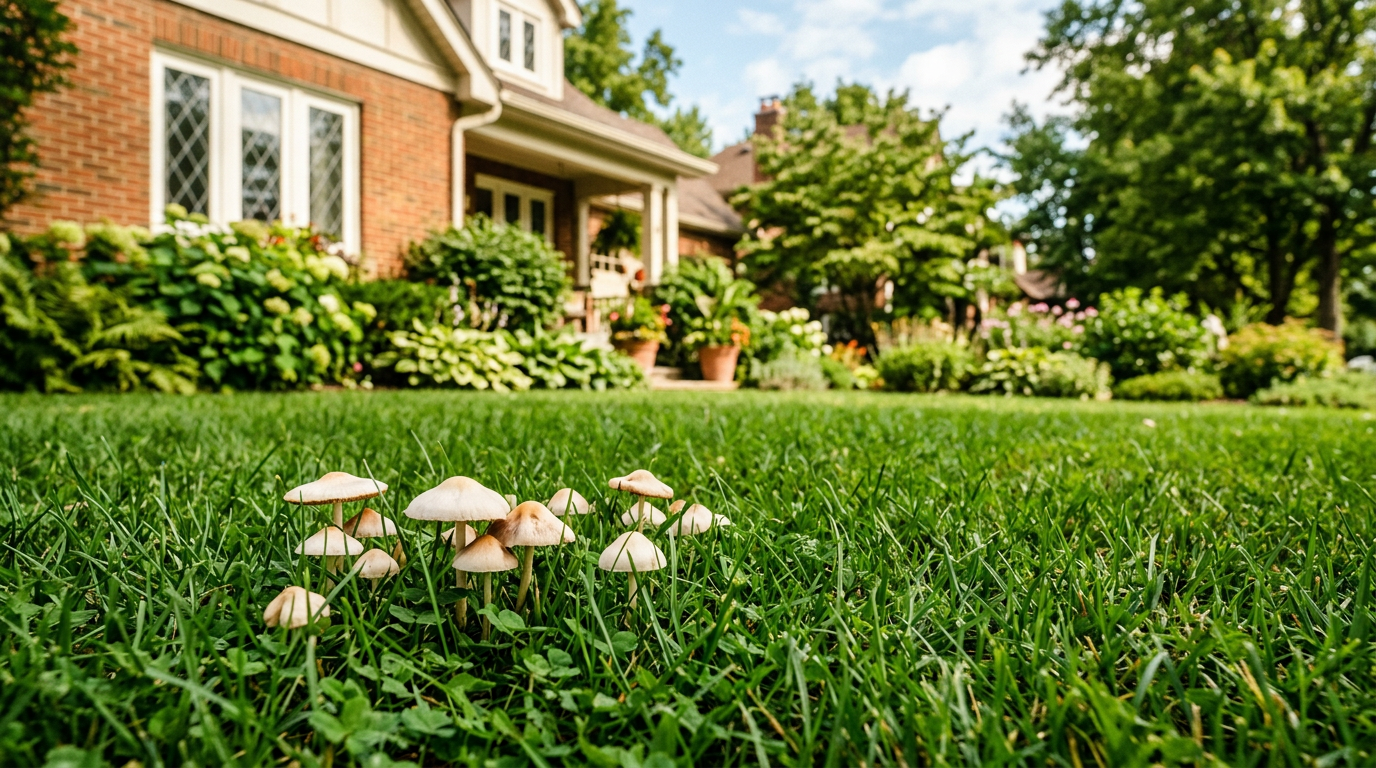
Mushrooms popping up after rain? Relax. They’re the fruiting bodies of fungi digesting buried wood, old roots, or thatch. They aren’t “eating” your living grass. They do signal extra moisture and organic debris—things we can fix. We’ve chased plenty of fairy rings on client lawns; here’s the short and long game that actually works.
Why mushrooms grow in lawns
- Excess moisture and shade keep the soil damp longer than it should.
- Buried organic matter (old stumps, construction lumber scraps, thick thatch) feeds saprophytic fungi.
- Compacted or hydrophobic soil holds water at the surface and starves roots below, making rings stronger.
- After a good soaking rain, mushrooms can appear overnight—that’s normal sporulation.
If you see dark-green rings or arcs with mushrooms, that’s likely a fairy ring. Some rings repel water (dry, tan grass inside the ring) and need extra steps.
Fast fixes this week
- Pick or mow-and-bag the caps as they appear. It won’t kill the fungus underground, but it cuts mess, spores, and pet risk. Wear gloves and trash them.
- Water smarter: target 1 inch/week total (including rain). Use a tuna can to measure and irrigate deeply, not daily.
- Rake out obvious wood bits and heavy thatch. A thatch layer >0.5 inch is a fungus buffet.
- Improve airflow and sun if you can (raise mower to 3–3.5 inches; prune dense lower branches).
Named tools that help fast:
- Ames 15-in Thatch Rake (2915100) — about $43
- Chapin 1‑Gal Garden Sprayer (20000) — about $16
A numbers check on water and waste
As much as 50% of outdoor water is wasted by wind, evaporation, and runoff from inefficient irrigation. Overwatering fuels mushroom flushes and shallow roots. Audit your schedule and cut runtime, not frequency, to hit just 1 inch/week. (https://www.epa.gov/watersense/outdoor)
Long-term prevention that actually sticks
- Core aerate packed soil. Pulling plugs opens channels for air/water and speeds decomposition of thatch.
- Yard Butler Lawn Coring Aerator — about $99
- Dethatch if the layer is >0.5 inch. Do this in your grass’s active growth season.
- Sun Joe AJ801E Dethatcher/Scarifier — about $139
-
Topdress light (1/4 inch) with compost after aeration to boost microbes that finish off buried wood.
-
Fix drainage. Low spots? Add soil to level. Chronic soggy area? Consider a short French drain or redirect downspouts.
-
Feed, don’t overfeed. For cool-season lawns, 0.5–0.75 lb N/1,000 sq ft in early fall strengthens turf without spiking thatch. Example products:
- Scotts Turf Builder 32‑0‑4 (covers 12,000 sq ft) — about $60
- Luster Leaf Rapitest Soil Test Kit (1601) — about $15
When fungicide is worth it (fairy ring cases)
Fungicides don’t matter for random mushrooms. They’re for confirmed fairy rings causing hydrophobic soil or dead arcs. The play:
- Core aerate the ring area densely.
- Apply a wetting agent and water in to break hydrophobic soil.
- Then apply a strobilurin fungicide (azoxystrobin) and water to the root zone.
Products:
- Scotts DiseaseEx Lawn Fungicide (azoxystrobin) — about $24 (10 lb, 5,000 sq ft)
- BioAdvanced Fungus Control for Lawns (propiconazole) — about $20 (hose-end)
Always follow label rates. Expect multiple applications on 14–28‑day intervals for stubborn rings. University turf programs recommend combining aeration + wetting agent + azoxystrobin for best results on Type II/III fairy rings.
Safety notes: kids, pets, and wild mushrooms
Many lawn mushrooms are toxic or irritating—even if the fungus itself is harmless to turf. Remove caps promptly, wear gloves, and trash them sealed. Don’t compost unknown mushrooms. If ingestion occurs, contact Poison Control.
Related lawn problems to rule out
Mushrooms are one thing; turf diseases are another. If you’ve got yellow/tan patches without mushrooms, or slime, you might be seeing disease instead of saprophytic fungi. Use our fast visual guide and troubleshoot other suspects:
- Lawn Fungus Identification: Pictures, Symptoms, Fixes
- Brown Patches in Lawn After Winter: Causes + Fixes
- White Grubs in Soil Identification: Pictures, Look‑Alikes
- Tiny Holes in Lawn at Night: What’s Making Them + Fixes
Our field notes
We’ve had lawns where mushrooms vanished after two simple moves: cutting irrigation 30% and core aerating before a compost topdress. For real fairy rings, azoxystrobin only worked after we punched holes and watered in a wetting agent first. The setup matters more than the spray.
Frequently asked
Are mushrooms in my lawn bad for the grass?+
Usually no. They’re feeding on dead wood, roots, or thatch, not living turf. They’re a moisture/organic matter signal. Remove caps for tidiness and safety, then fix watering, thatch, and compaction. Only treat with fungicide if you’ve got true fairy ring causing hydrophobic soil or turf decline.
How do I stop mushrooms from coming back?+
Reduce moisture (1 inch/week total), improve drainage, core aerate, dethatch thick thatch, and topdress with compost. Remove buried wood if you find it. In persistent fairy rings, combine aeration + wetting agent + azoxystrobin fungicide per label to break the cycle.
Is it safe for dogs or kids if mushrooms grow in my lawn?+
Wild lawn mushrooms can be toxic. Wear gloves, pick and trash caps promptly (sealed bag), and avoid composting them. Supervise pets and kids until you’ve cleared mushrooms and corrected moisture issues. If ingestion occurs, contact Poison Control right away.
Will vinegar, salt, or baking soda kill lawn mushrooms?+
Skip the kitchen chemistry. Vinegar and salt can burn turf and soil life, and baking soda is inconsistent. You’ll only scorch the surface and not touch the underlying fungus. Mechanical removal plus fixing moisture, thatch, and compaction is the durable solution.
Do I need a fungicide for random mushrooms after rain?+
No. Random post‑rain mushrooms don’t justify fungicide. Pick them and focus on water, thatch, and soil structure. Save fungicides for confirmed fairy rings that cause hydrophobic soil or turf decline, and combine with aeration and a wetting agent for best results.