
Summer Watering Guide for Lawns: The No-Nonsense Rules
Stop guessing and start watering your lawn like a pro this summer. We're cutting through the noise to give you the only guide you'll ever need to keep your grass green when the heat is on.
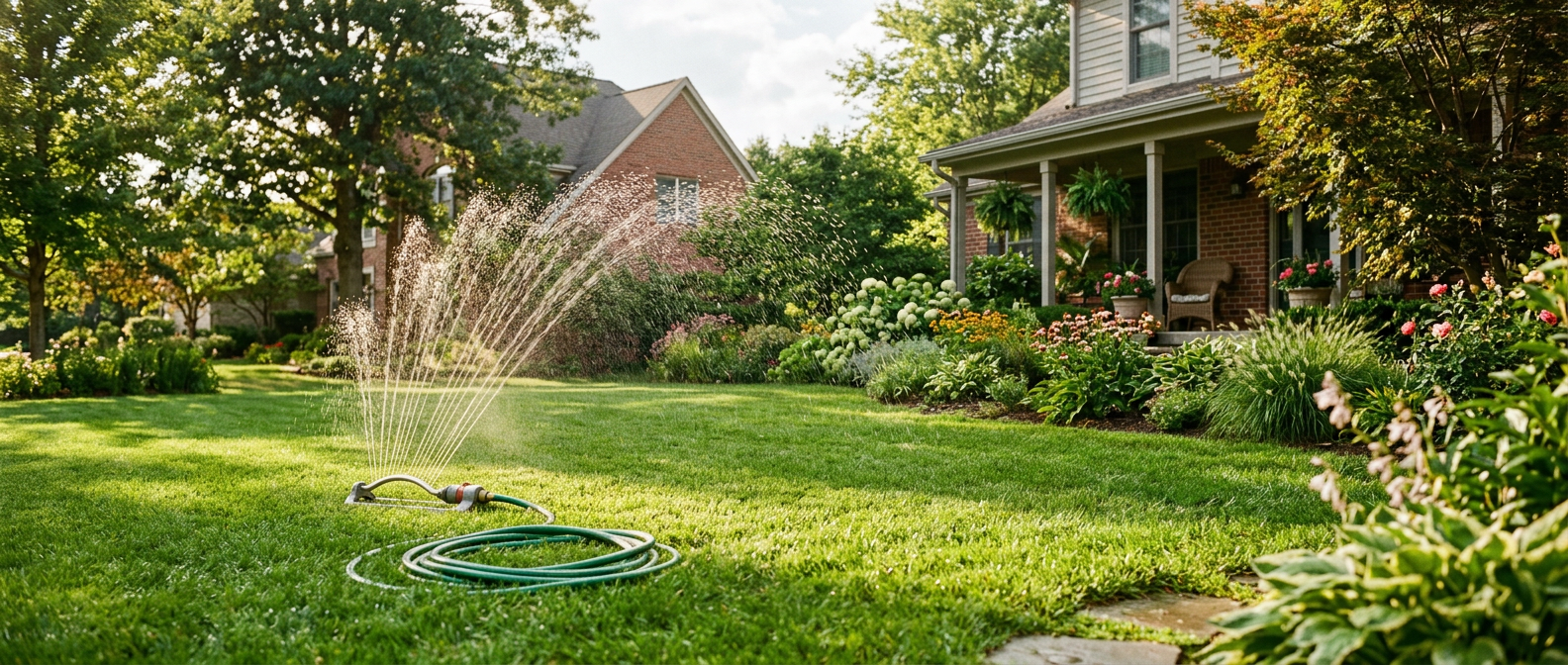
Let's be honest: watching your lawn turn into a crunchy, brown wasteland every summer is demoralizing. You see neighbors with lush, green carpets and wonder what expensive, secret potion they're using. The secret isn't a potion. It's just watering smarter, not harder.
We've seen every mistake in the book—watering at high noon, sprinkling for five minutes every day, and wondering why mushrooms are the only thing thriving. This guide is your intervention. We're going to break down summer lawn watering into a few simple, no-nonsense rules that work for pretty much everyone, everywhere.
When to Water Your Lawn (and When Not To)
Timing is everything. Water at the wrong time of day, and you're basically just giving half your water bill back to the sun as steam.
The absolute best time to water your lawn is in the early morning, between 4 a.m. and 10 a.m.
Here’s why:
- Less Evaporation: The sun is low, winds are calmer, and temperatures are cool. More water gets to the soil and roots where it's needed, instead of vanishing into the air. According to the EPA, as much as 50% of water used outdoors can be lost to wind and evaporation, largely from inefficient, mid-day watering. (Source: https://www.epa.gov/watersense/statistics-and-facts)
- Disease Prevention: Watering in the evening might seem logical, but it's a terrible idea. When grass blades stay wet all night in cool, damp conditions, you're rolling out the welcome mat for fungal diseases like brown patch and dollar spot. Morning watering allows the grass blades to dry off quickly as the sun rises.
Never, ever water in the middle of the afternoon. It's the least efficient time possible. You'll lose a huge percentage to evaporation and can even scorch the grass blades if the sun is intense enough.
How Much Water Does Your Lawn Actually Need?
Forget the guesswork. The universal rule of thumb for most established lawns is 1 to 1.5 inches of water per week, including rainfall. That's it.
The key is how you deliver that inch. It's not about a quick spritz. You need that water to soak deep into the soil.
The Tuna Can Test: Your New Best Friend
How do you know how long it takes to put down one inch of water? Easy. You perform a highly scientific experiment using empty cans.
- Grab a few empty, clean tuna or cat food cans (any small, straight-sided can works).
- Place them randomly around your lawn in the area your sprinkler covers.
- Turn on your sprinkler and time how long it takes for the cans to collect, on average, one inch of water.
Let's say it takes 45 minutes. Now you know that running that sprinkler zone for 45 minutes delivers one inch of water. If you're aiming for 1.5 inches a week, you'll need to run it for about 67 minutes total per week.
Deep and Infrequent is the Mantra to Memorize
This is the single most important concept in lawn watering. Water deeply and infrequently.
Here’s what that means in practice: Instead of watering for 10 minutes every day, you should water for a longer period (e.g., 30-45 minutes) just two or three times a week.
Why? Because deep watering forces the grass roots to grow deeper in search of moisture. A deep root system makes your lawn incredibly resilient to drought and heat. Shallow, daily watering does the opposite. It encourages a shallow, lazy root system that's weak and completely dependent on its daily fix. When a heatwave hits, those shallow-rooted lawns are the first to die.
So, if your "tuna can test" showed it takes 45 minutes to apply one inch of water, a good schedule would be to water for about 22-23 minutes on Tuesday, Friday, and Sunday. That delivers your 1+ inch of water for the week, deeply and infrequently.
Choosing Your Watering Weapon: Sprinklers and Systems
You don't need a crazy-expensive system, but the right tool makes the job easier and more efficient.
- For Small to Medium Lawns: A simple oscillating sprinkler is a workhorse. The Melnor XT Oscillating Sprinkler with 20 Nozzles (around $25-$35) provides excellent, even coverage and is fully adjustable.
- For Large or Irregular Lawns: An impact sprinkler can cover a huge radius. The classic Rain Bird 25PJDAC Brass Impact Sprinkler (about $20) is nearly indestructible and has been a contractor favorite for decades.
- The Smart Upgrade: If you have an in-ground system, the single best investment you can make is a smart irrigation controller. The Rachio 3 Smart Sprinkler Controller (starting around $200) uses local weather forecasts, soil type, and plant type to create automatic watering schedules. It will skip watering when it rains and adjust for heatwaves. In our experience, it pays for itself in water savings within a couple of seasons.
Reading the Signs: Is Your Lawn Thirsty or Drowning?
Your lawn will tell you what it needs. You just have to learn the language.
Signs of an Under-watered (Thirsty) Lawn:
- The Footprint Test: Walk across your lawn. If your footprints remain pressed into the grass for more than a few seconds, the blades lack the moisture to spring back. It's thirsty.
- Color Change: Grass under drought stress will often take on a dull, bluish-gray or smoky-green color before it turns brown.
- Curled Blades: The blades of grass will start to fold or curl in half lengthwise to conserve water.
Signs of an Over-watered (Drowning) Lawn:
- Spongy/Squishy Feel: The ground feels soggy long after you've watered.
- Excessive Weeds: Crabgrass and nutsedge absolutely love overly wet conditions.
- Runoff: If water is running off your lawn onto the sidewalk, the soil is saturated and can't absorb any more.
- Fungus/Mushrooms: A constant presence of mushrooms or visible fungal patches is a dead giveaway you're overdoing it.
Regional Realities: Adjusting for Your Climate
The "1.5 inches per week" rule is a great starting point, but reality requires adjustment. A lawn in arid Arizona needs a different approach than one in the humid Southeast or the temperate Pacific Northwest.
- Hot & Humid (The Southeast): In places like Florida and the Gulf Coast, high humidity means you need to be extra vigilant about fungal diseases. Stick strictly to morning watering. You may also find that your grass, like St. Augustine, needs slightly more water during peak heat. For detailed timing, check out a local guide, like this Florida lawn care schedule.
- Hot & Arid (The Southwest & Texas): In the punishing sun of Texas or the desert climate of Southern California, evaporation is your biggest enemy. Sandy soils drain quickly and may require that 1.5 inches to be split into more frequent applications. The core principle of deep watering still applies, but you might water every other day instead of every three. Consider drought-tolerant alternatives, which you can see in guides to Southern California drought landscaping that can save a ton of water.
- Temperate & Mild (The Midwest & New England): In places like Illinois or Massachusetts, you have more leeway. You may only need 1 inch per week, and a single good rainstorm might cover you completely. Pay close attention to your local forecast and use the footprint test regularly. You can often get away with watering just once a week. Growing the right plants helps, too, like these Midwest perennials for full sun.
- Mountain & High Plains (Colorado): Places with high altitude, low humidity, and intense sun, like Colorado, present unique challenges. Water evaporates quickly, and cool nights can mask the daytime stress on turf. Consistency and sticking to the morning schedule is vital. For more on this unique environment, see our landscaping ideas for Colorado.
Ultimately, the rules are simple: Water early. Water deep. Know how much you're putting down. Your lawn—and your wallet—will thank you.
Frequently asked
Is it OK to water your lawn every day in the summer?+
No, it's generally a bad idea. Daily, shallow watering encourages a weak, shallow root system that makes your lawn less resilient to heat and drought. It's much better to water deeply and less frequently, such as 2-3 times per week, to promote strong, deep roots.
What is the best time to water grass in 100-degree weather?+
Even in extreme 100-degree heat, the best time to water is very early in the morning, before 10 AM. This ensures the water is absorbed by the soil and roots before the intense sun can cause it to evaporate, maximizing efficiency and minimizing waste.
Should grass be watered in the sun?+
You should avoid watering your lawn in direct, intense sun. Watering mid-day leads to significant water loss from evaporation and can even risk scorching grass blades. Always aim for early morning watering when the sun is low and temperatures are cool for the best results.
How long should I water my lawn in summer?+
The goal is to apply 1 to 1.5 inches of water per week. The time this takes depends on your sprinkler's output. Use the 'tuna can test' to measure how long it takes to collect one inch of water, then divide that time over 2-3 watering sessions per week.
Can you overwater grass in summer?+
Yes, you can absolutely overwater grass in the summer. Overwatering leads to shallow roots, fungal diseases like brown patch, and can literally drown the plant's roots by starving them of oxygen. It also promotes weed growth and wastes a significant amount of water.