
Southern California Drought Landscaping That Doesn't Suck
Stop fighting the climate. Here's how to create a gorgeous, low-water landscape in Southern California that saves money and looks amazing year-round.
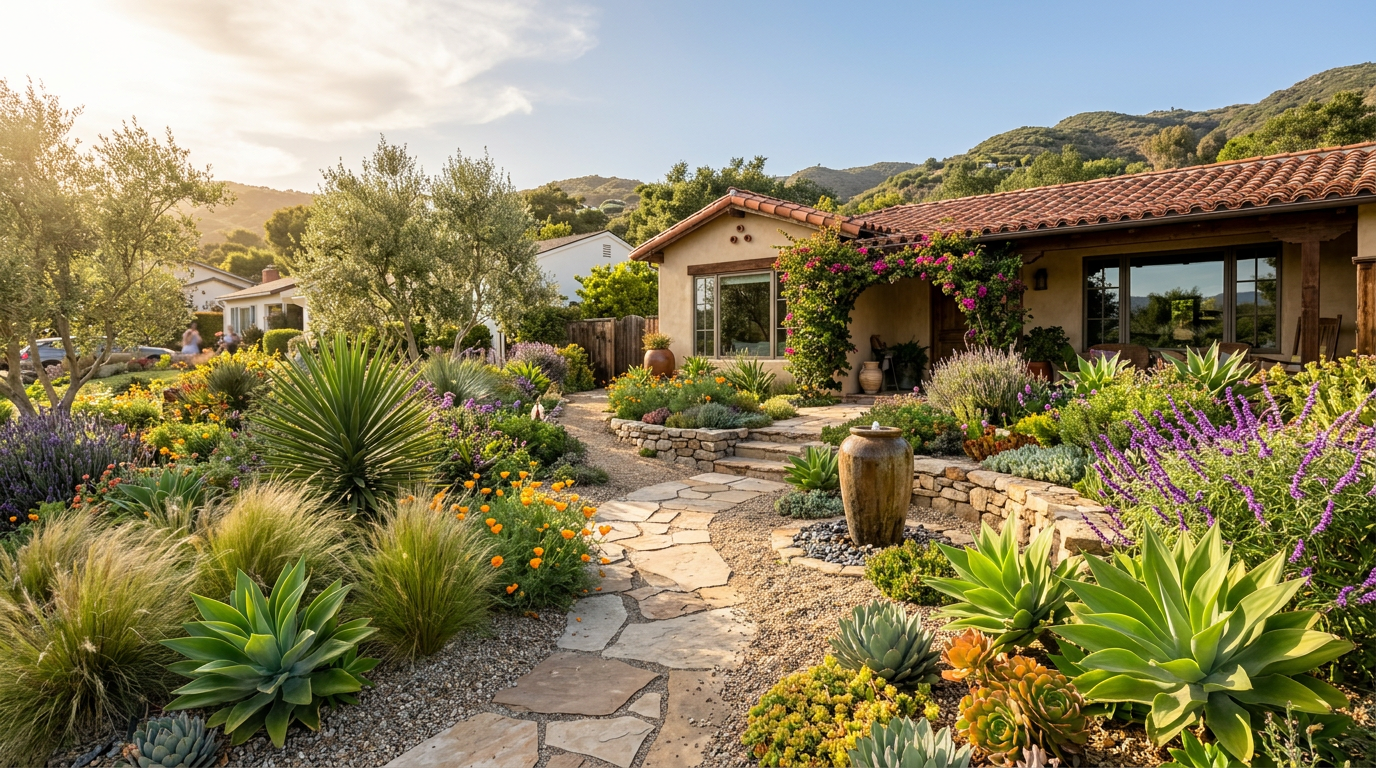
Let's be real: trying to maintain a lush, green, Kentucky-bluegrass-style lawn in Southern California is like trying to ski in downtown Los Angeles. It's expensive, requires a ton of artificial support, and frankly, looks a little ridiculous. The era of endless water is over. But that doesn't mean your yard has to be a barren wasteland of rocks and a single, sad-looking cactus. We're here to tell you that smart, beautiful, and vibrant Southern California drought landscaping isn't just possible—it's better.
This is your no-nonsense guide to creating a landscape that thrives in our sunny, dry climate, saves you a boatload of money on your water bill, and actually looks incredible. Forget the gatekeeping and the confusing botanical jargon. We're talking practical steps for real SoCal yards, from San Diego to Santa Barbara.
Understanding Southern California's Water Reality
First, a quick reality check. We live in a Mediterranean climate. That means hot, bone-dry summers and mild, kinda-wet winters. Our water is mostly imported from hundreds of miles away, and its supply is anything but guaranteed. This isn't a temporary drought; it's a permanent climate reality. Fighting it is a losing battle. The good news is, embracing it opens up a world of stunning, resilient plants and design styles.
Landscape irrigation is the single largest residential water user. According to the California Department of Water Resources, outdoor watering can account for a staggering 60% of a home's water consumption, especially in the hotter inland areas. Slashing that number is the single biggest impact you can make. The goal isn't just to use less water, but to create a landscape so well-adapted it barely needs any extra water to begin with.
Step 1: Break Up With Your Thirsty Lawn
The emerald green lawn is Public Enemy Number One in a water-wise garden. A typical lawn requires about 55 gallons of water per square foot per year. That's insane. The most impactful thing you can do is get rid of it, or at least shrink it dramatically.
Before you panic, this is an upgrade. Local water agencies are literally paying people to do this. The Metropolitan Water District's SoCal Water$mart program frequently offers a turf replacement rebate, often around $2 per square foot. Check their site or your local water provider's for the current details. You can get paid to improve your yard and lower your bills.
What do you replace it with? You have options:
- Permeable Hardscape: Decomposed granite (DG), gravel, or pavers create beautiful, usable patios and pathways that let rainwater soak into the ground. A DG patio costs about $15-25 per square foot installed, but you can DIY it for much less.
- Native Groundcovers: Plants like Silver Carpet (Dymondia margaretae) or Creeping Thyme create a lush, green carpet that handles some foot traffic and uses a fraction of the water of turf.
- High-Quality Artificial Turf: If you absolutely need a patch of green for kids or pets, modern artificial turf has come a long way. Brands like SYNLawn look surprisingly realistic and have a life expectancy of 15-20 years. No watering, no mowing, no fuss.
Plant Selection for a Killer Southern California Garden
This is the fun part. Forget the sad, thirsty petunias. We're building a garden with plants that actually want to live here. Think of it like a Hollywood cast of tough, gorgeous, low-maintenance characters. Similar to the rugged beauty you'll find in Arizona desert landscaping ideas, SoCal has its own all-star team of native and climate-adapted plants.
Head to a specialty nursery like the Theodore Payne Foundation in Sun Valley or the native section at your local Armstrong Garden Centers to find these gems.
Here are a few of our favorites:
- Trees: Instead of a messy, thirsty Ficus, plant a Coast Live Oak (Quercus agrifolia) for shade and habitat, or a Western Redbud (Cercis occidentalis) for stunning spring flowers.
- Shrubs: Ceanothus, also known as 'California Lilac,' is the undisputed king. Varieties like 'Concha' and 'Ray Hartman' explode with blue or purple flowers in the spring and need zero summer water once established. Manzanita (Arctostaphylos) offers beautiful bark and structure year-round. Toyon (Heteromeles arbutifolia) is called 'Christmas Berry' for its bright red winter berries that feed local birds.
- Perennials & Succulents: In our own test garden in Oceanside, we've had incredible success with Salvia species. Cleveland Sage (Salvia clevelandii) has an intoxicating fragrance, while Hummingbird Sage (Salvia spathacea) thrives in dry shade. And of course, Agaves, Aloes, and Dudleyas provide bold, sculptural forms that scream Southern California.
- Grasses: Forget the turf and embrace ornamental grasses. Deer Grass (Muhlenbergia rigens) is a workhorse, forming large, graceful clumps that look amazing backlit by the sun.
Smart Irrigation: The Brains of Your SoCal Landscape
Even drought-tolerant plants need some water to get established. But the way you deliver it matters. It's time to ditch the inefficient, water-spewing spray heads that water your sidewalk more than your plants.
Drip Irrigation is non-negotiable. A drip system delivers water directly to the root zone of each plant, eliminating runoff and evaporation. It's over 90% efficient, compared to 50-70% for traditional sprinklers.
Pair your drip system with a smart irrigation controller. These Wi-Fi enabled devices are the brains of the operation. A product like the Rachio 3 Smart Sprinkler Controller (around $230 on Amazon) or the Hunter Pro-HC uses local weather data to automatically adjust watering schedules. It won't water if it just rained or if a Santa Ana wind is about to kick up. Many water districts also offer rebates of $50-$100 for purchasing one of these, so it can pay for itself quickly.
Remember the mantra: water deeply and infrequently. This encourages plants to grow deep, resilient roots, making them tougher and even more drought-tolerant. While some climates need different strategies, like the careful scheduling for Texas lawn care, our dry heat demands this deep-soak approach.
Mulch: Your Landscape's Best Friend
If you do only one thing after planting, do this: apply a thick layer of mulch. Mulch is the unsung hero of the water-wise garden. It's a protective blanket for your soil that:
- Reduces water evaporation by up to 70%.
- Suppresses weeds that compete for water and nutrients.
- Keeps soil temperatures cool in the summer and warm in the winter.
- Breaks down over time (if organic) to improve soil health.
We recommend a 3-4 inch layer. You can get shredded cedar or bark mulch from any big-box store for about $4 a bag, or have it delivered in bulk from a local supplier like Whittier Fertilizer Co. for around $40-50 per cubic yard. For a cleaner, more modern look, consider inorganic options like decomposed granite or pea gravel, though they run a bit more at $70-100 per yard.
Bringing It All Together in Southern California
So what does this look like? Imagine a front yard where a winding decomposed granite path leads to your door. Instead of a dead lawn, you have sculptural mounds planted with a silver-leafed Manzanita, spikes of deep blue Salvia, and the soft texture of Deer Grass. A few strategically placed boulders add naturalistic structure. The whole area is covered in a thick layer of dark brown mulch, and a nearly invisible drip irrigation system keeps everything happy on one watering every two weeks in the summer.
It's beautiful. It's full of life. It smells amazing after a rain. It's a landscape that belongs in Southern California, celebrating our climate instead of fighting it. It's a far cry from the flat, boring yards in other regions, and it's something you can be proud of. Much like you wouldn't try to plant a palm tree in the Rockies, we shouldn't be fighting to grow fescue here. It's about working with what you've got, a principle that applies even to tougher climates like the one tackled in these landscaping ideas for Colorado. Now go rip out that lawn.
Frequently asked
What is the best ground cover for Southern California?+
The best drought-tolerant ground covers include Dymondia margaretae (Silver Carpet) for sunny, walkable areas, and native options like 'Yankee Point' Ceanothus for slopes. These require minimal water once established, suppress weeds, and provide a lush, green look without the demands of a traditional lawn.
How do I landscape my yard without grass in California?+
Replace grass with a mix of permeable hardscaping like decomposed granite or pavers, and planting beds filled with native shrubs and perennials. Use a thick layer of mulch to conserve water. This creates a visually interesting, low-maintenance, and water-wise yard that's perfect for California.
What is the cheapest drought-tolerant landscaping?+
The cheapest approach is sheet mulching to kill your lawn and then planting small, young native plants or seeds. Use free mulch from local tree trimming services (via ChipDrop) and focus on plants that propagate easily, like succulents. This DIY method saves on labor and mature plant costs.
Can I get paid to remove my grass in California?+
Yes. Many water districts in Southern California offer turf removal rebates. The SoCal Water$mart program, for example, often provides rebates per square foot of grass removed and replaced with water-wise landscaping. Check your local water agency's website for current program details and funding availability.