
Southern California Drought Landscaping That Doesn't Suck
Let's be real, keeping a lush green lawn in SoCal is a fool's errand. We'll show you how to create a stunning, water-wise landscape that thrives in our dry climate, regulations and all.
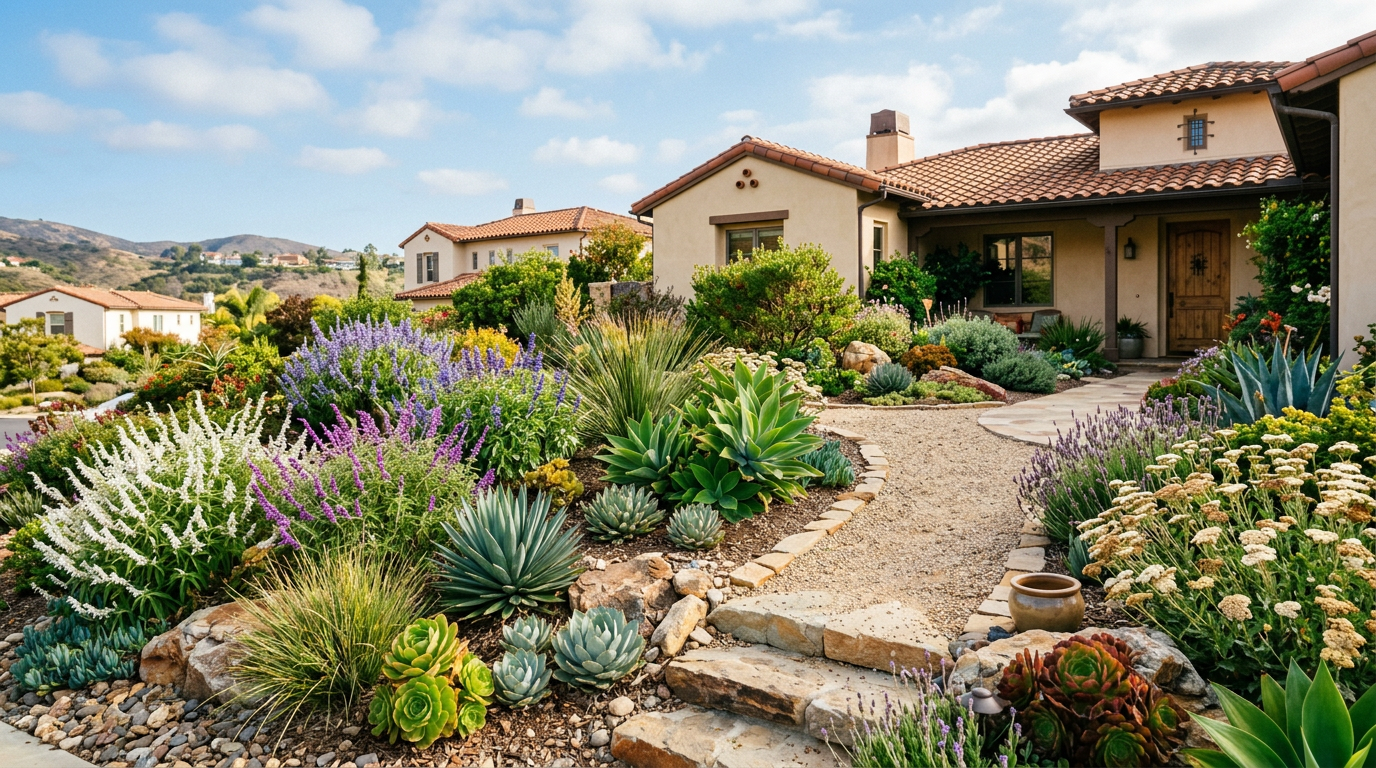
Look, we get it. You moved to Southern California for the sunshine, not to stare at a brown, crunchy lawn that costs a fortune to keep alive six months out of the year. For decades, the default American landscape has been a water-guzzling carpet of green grass. In the arid West, that's not just a bad idea; it's an expensive, unsustainable one. The era of endless water is over, and our landscaping needs to catch up.
This isn't about surrendering to a barren moonscape of rocks and cactus. It’s about being smart. It's about creating a vibrant, beautiful yard that works with our Mediterranean climate, not against it. This is your no-nonsense guide to Southern California drought landscaping that saves water, slashes your bills, and looks incredible.
Why Your Kentucky Bluegrass Has to Go: The Hard Truth for Southern California
That patch of turfgrass is the single thirstiest plant in your entire yard. A typical lawn requires about 55 gallons of water per square foot per year. For a small 1,000-square-foot lawn, that’s 55,000 gallons of water. Let that sink in. It's an environmental and financial drain that makes zero sense in a region prone to severe, prolonged droughts.
Water agencies like the Metropolitan Water District of Southern California (MWDSC) aren't playing around anymore. They impose strict watering schedules (e.g., two days a week, 8 minutes per station) and will fine you for runoff. Fighting this reality is a losing battle. Your water bill will continue to climb, and your lawn will continue to struggle.
So, let's stop fighting. Let's rip out the problem at the root. Removing your lawn is the single biggest impact you can make. Think of it as landscape liberation. You're freeing yourself from the weekly chore of mowing, the constant need for fertilizers and pesticides, and the guilt of watching precious water evaporate into the dry SoCal air.
Rebates and Free Money: Getting Paid to Rip Out Your Southern California Lawn
Here’s the best part: you can get paid to do the right thing. To encourage water conservation, local water districts offer some seriously attractive turf replacement rebates.
The most prominent program is the SoCalWater$mart Turf Replacement Program. As of late 2023, they offer a base rebate of $2 per square foot of turf removed. Many local water agencies sweeten the deal with their own additional rebates. For example, the Los Angeles Department of Water and Power (LADWP) often bumps that up to $5 per square foot. For a 1,000-square-foot lawn, that’s $5,000 back in your pocket. That’s not a typo.
Here's the process in a nutshell:
- Measure and Photograph: Measure the square footage of the lawn area you plan to remove. Take 'before' photos.
- Apply Online: Visit the SoCalWater$mart website. You'll submit your project details, photos, and a rough plan for what you'll replace the turf with (they want to see at least three plants per 100 sq ft).
- Wait for Approval: Do NOT start work until you receive a formal Notice to Proceed. This usually takes a few weeks.
- Do the Work: Once approved, you have 180 days to remove the turf and complete your new landscape.
- Get Paid: Submit 'after' photos and any required documentation. A check will arrive in the mail. It's one of the best deals in home improvement.
The Foundation: Hardscaping and Groundcovers for SoCal Yards
Once the lawn is gone, you have a blank canvas. Don't just fill it with plants. A great drought-tolerant design balances plant life with hardscape and permeable groundcovers. These elements provide structure, create usable space, and require zero water.
-
Decomposed Granite (DG): This is our go-to for patios, pathways, and seating areas. DG is a fine, sandy rock material that compacts to a firm, natural-looking surface. It's permeable, so rainwater soaks into the ground instead of running off. Expect to pay around $60-$85 per cubic yard from a local supplier like Whittier Fertilizer or Bourget Bros. in Santa Monica. For a more stable finish, use a stabilizer-mixed DG, which costs a bit more but prevents erosion and tracking.
-
Mulch: Never leave bare soil. A thick 3-4 inch layer of organic mulch is your best friend. It suppresses weeds, retains soil moisture, and keeps roots cool. The best mulch is arborist wood chips, which you can often get for free from services using the ChipDrop app. Bagged bark from Home Depot or Lowe's works too, but it's more expensive and less beneficial.
-
Paths and Patios: Use flagstone, pavers, or concrete slabs to create durable, beautiful walking surfaces and outdoor rooms. Setting flagstones with 2-3 inch gaps and filling them with a walkable groundcover like Dymondia or creeping thyme looks fantastic and allows water to penetrate. For some great visual ideas on combining stone and arid plants, check out these Arizona desert landscaping ideas that don't suck.
The Plant Palette: Southern California's All-Star Drought-Tolerant Plants
This is the fun part. Choosing plants that thrive here is key. We're talking about a palette of silvers, deep greens, and surprising bursts of color. A great local resource is the Theodore Payne Foundation in Sun Valley, which specializes in California natives. For a broader, well-curated selection, Armstrong Garden Centers are reliable.
Here are some of our proven winners:
-
Structural Stars (Trees & Large Shrubs):
- Toyon (Heteromeles arbutifolia): A beautiful native evergreen with white spring flowers and bright red winter berries. A true four-season plant.
- Ceanothus ('California Lilac'): From groundcovers to large shrubs, these natives explode with blue or purple flowers in the spring and are magnets for pollinators.
- Cleveland Sage (Salvia clevelandii): The quintessential scent of the chaparral. Whorls of lavender-blue flowers and fragrant, grey-green foliage.
- Bougainvillea: A non-native, but it's a classic for a reason. Thrives on neglect and heat, providing insane amounts of color with very little water once established.
-
Mid-Layer Fillers (Perennials & Grasses):
- Yarrow (Achillea millefolium): Tough as nails, comes in colors from yellow to pink to white. Fern-like foliage is lovely even when not in bloom.
- Hummingbird Sage (Salvia spathacea): A spreading groundcover with large, fruity-scented leaves and spikes of magenta flowers that hummingbirds adore.
- Deer Grass (Muhlenbergia rigens): A large, graceful native bunchgrass that provides structure and movement. Looks amazing when backlit by the sun.
-
Low-Level Jewels (Succulents & Groundcovers):
- Agave attenuata: The 'Foxtail Agave'. Spineless, with beautiful rosettes of soft, pale green. A sculptural masterpiece.
- Dudleya: Our native succulents. They look like stony rosettes and are perfectly adapted to our dry summers (they go dormant, so don't water them!).
- Rosemary (trailing): Spills beautifully over walls and banks, providing fragrance, culinary use, and year-round green.
While our friends tackling Texas lawn care are sweating over their St. Augustine grass, we're building a resilient ecosystem that thrives with minimal intervention.
Smart Watering: Drip Irrigation is Your New Best Friend
Sprinklers are for lawns. For a garden of individual plants, they're horribly inefficient. They spray water everywhere—on leaves, on mulch, on your driveway—where most of it evaporates. Drip irrigation is the solution. It's a network of tubing with small emitters that deliver water slowly and directly to the root zone of each plant.
Converting a pop-up sprinkler system is surprisingly easy. You can buy kits like the Rain Bird 1800-RETRO for about $20 that screw right onto your existing sprinklers, converting the head into a multi-outlet drip manifold.
According to the EPA WaterSense program, a typical home can save over 15,000 gallons of water annually by switching to a water-smart landscape and irrigation system. (Source: https://www.epa.gov/watersense/outdoors). In a city like San Diego, where water rates can exceed $10 per HCF (748 gallons), that's a real savings of over $200 per year, every year.
Pair your drip system with a smart controller like the Rachio 3 (around $200) or the Orbit B-hyve (around $100). These Wi-Fi enabled controllers use local weather data to automatically adjust watering schedules. It won't water if it just rained or if a heatwave is coming. This is set-it-and-forget-it efficiency.
Putting It All Together: A Sample Southern California Drought Garden Plan
Okay, theory is great, but what does this actually look like? Here’s a layout we designed for a client's 500-square-foot front yard in Pasadena. The goal was curb appeal, low maintenance, and zero lawn.
- The 'Un-Lawn': We removed the turf and created a large, amoeba-shaped central planter bed. The area outside the bed became a patio and walkway using stabilized gold decomposed granite.
- The Dry Creek Bed: We built a shallow, winding dry creek bed through the planter using a mix of river rocks and larger pebbles. This adds visual interest and helps manage rainwater during our infrequent winter storms.
- Hydrozoning: We grouped the plants by water needs. This is the most important concept most people miss. Don't put a thirsty plant next to a cactus.
- Zone 1 (Lowest Water): Along the sunniest, driest edge, we planted a 'Blue Glow' Agave, some low-growing 'Chalk Dudleya', and a spilling mass of trailing rosemary.
- Zone 2 (Medium-Low Water): In the main body of the planter, we used three 'Concha' Ceanothus shrubs for structure, inter-planted with Deer Grass and the grey foliage of Cleveland Sage. This creates a soft, chaparral-like feel.
- Zone 3 (Medium Water): Near the front porch, where it gets a bit more shade and is easier to water, we put a patch of Hummingbird Sage and some colorful Yarrow. This gives a burst of color right by the entrance.
The entire area is covered in a 4-inch layer of dark brown mulch to unify the look and conserve moisture. The watering is handled by a single drip line with different emitters (0.5 GPH, 1 GPH, 2 GPH) tailored to each plant's needs. The result is a dynamic, beautiful garden that's a world away from the challenges seen in places like the Rockies, where they have completely different constraints for their landscaping ideas for Colorado.
Embracing Southern California drought landscaping isn't a compromise. It’s an upgrade. It’s a chance to create a unique, personal space that reflects the beauty of our region. It saves you time, money, and our most precious resource: water. So grab a shovel, turn off the sprinklers, and start building the SoCal garden you deserve.
Frequently asked
How much does drought landscaping cost in Southern California?+
Initial costs can be higher than turf, ranging from $5-$20 per square foot depending on the complexity and materials. However, substantial water savings and rebates from programs like SoCalWater$mart can lead to a full return on investment in just 3-5 years.
Can I still have some grass in my SoCal yard?+
Yes, but choose wisely. Consider highly drought-tolerant turf varieties like UC Verde Buffalograss or a groundcover alternative like Kurapia. These can use up to 70% less water than traditional fescue. We recommend limiting grass to small, functional play areas.
What's the best mulch for a Southern California garden?+
Arborist wood chips are the gold standard. They're often free from local tree services, retain moisture excellently, suppress weeds, and improve soil health as they decompose. Avoid using rock mulch over bare soil in sunny areas, as it can superheat the ground and harm plant roots.
How often do I water a new drought-tolerant landscape?+
New plants need regular water for the first 6-12 months to establish roots, typically once or twice a week. Once established, most native plants thrive with deep, infrequent watering every 2-4 weeks in summer and even less in winter, if at all.
Are there plants I should absolutely avoid in Southern California?+
Yes. Steer clear of water-guzzlers like Kentucky Bluegrass, traditional large-leaf hydrangeas, Japanese maples, and most ferns. These plants are ill-suited for our hot, dry Mediterranean climate and will struggle or die without excessive irrigation.