
PNW Landscaping Ideas for Washington Yards
Stop fighting the rain and start working with it. We're breaking down the best Pacific Northwest landscaping ideas for your Washington home, from native plants to moss-positive designs.
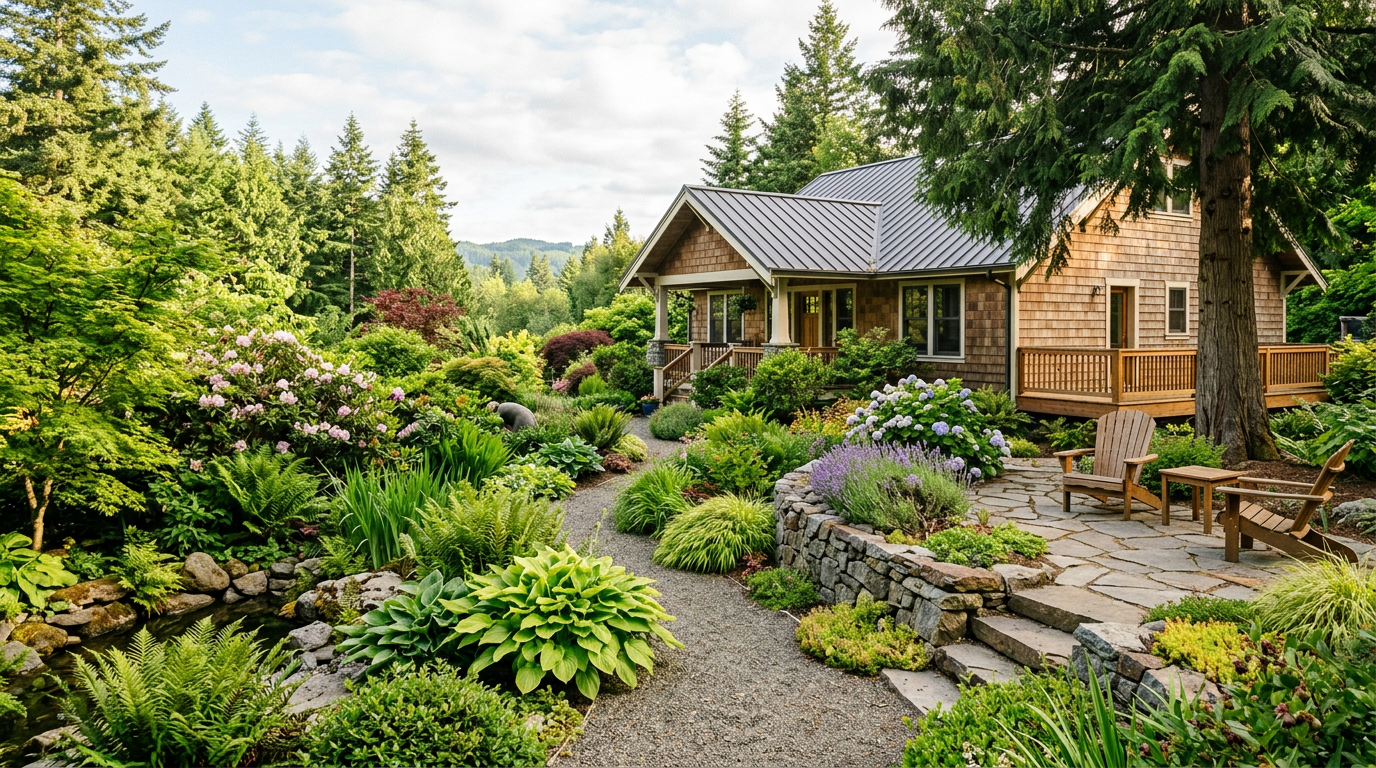
Let's be direct. Landscaping in Washington is a different beast. If you moved here from somewhere sunny and try to apply the same old rules, you're going to have a bad time. Your lawn will become a mossy sponge, your sun-loving perennials will rot, and you'll spend a fortune fighting a battle you can't win. We're here to tell you to stop fighting. The key to successful Pacific Northwest landscaping is to lean into what our climate does best: grow lush, green, and vibrant things that don't mind a little (or a lot of) rain.
This isn't about giving up and letting nature take over entirely. It's about being smart. It's about choosing the right plants and materials that work with our drizzly winters and glorious, mild summers. Forget the perfect, water-guzzling lawns you see in other states. Here in Washington, we can create something far more interesting, sustainable, and beautiful.
Stop Fighting the Rain: Native Plants for Your Washington Yard
The absolute number one rule for smart Washington landscaping is to use native plants. Why? Because they've spent thousands of years adapting to our specific conditions. They know how to handle our acidic, often clay-heavy soil. They're built for nine months of drizzle and three months of relative dryness. They provide food and shelter for local wildlife. It's a win-win-win.
Here's our go-to starter pack of bulletproof natives you can find at almost any local nursery, like Swansons Nursery in Seattle or The Garden Spot in Bellingham.
- Sword Fern (Polystichum munitum): The undisputed king of the PNW understory. This evergreen fern provides year-round structure and texture in shady spots. It's tough, dependable, and looks like it was pulled straight from the Hoh Rainforest. Expect to pay about $15-$20 for a healthy 1-gallon plant.
- Salal (Gaultheria shallon): A glossy, leathery-leafed evergreen shrub that can act as a tough, beautiful groundcover. It produces small, edible berries and is ridiculously low-maintenance once established.
- Oregon Grape (Mahonia aquifolium): This isn't a grape, but its berries look similar. It offers amazing four-season interest: fragrant yellow flowers in spring, blue-black berries in summer, and leaves that turn a stunning bronze-red in the winter sun. It's tough as nails.
- Evergreen Huckleberry (Vaccinium ovatum): A slower-growing but incredibly rewarding shrub. It has delicate pink flowers, delicious and edible berries (a local delicacy), and beautiful foliage that can be coppery-red when new. It thrives in acidic soil.
- Red Flowering Currant (Ribes sanguineum): One of the first signs of spring, this deciduous shrub bursts forth with pendulous clusters of brilliant pinkish-red flowers, providing a vital early food source for hummingbirds.
Using natives means less watering, less fertilizing, and less frustration. It's the cheapest, smartest way to a landscape that thrives.
Hardscaping for a Soggy Washington Climate
Water needs a place to go. In a state where consistent rainfall is a fact of life, traditional concrete patios and pathways can create drainage nightmares, leading to standing water and soggy lawns. The solution is permeable hardscaping.
Permeable surfaces allow rainwater to slowly percolate back into the ground, reducing runoff and recharging groundwater. It's environmentally friendly and solves a huge practical problem. While some states are forced into xeriscaping to save every drop, like in Southern California drought landscaping, our goal is managing abundance.
- Gravel and Crushed Rock Paths: This is the simplest, most cost-effective option. A path made of 1/4" minus crushed basalt (a beautiful local gray stone) packs down firmly but still allows water through. You can get a cubic yard of it delivered from a local supplier like Marenakos Rock Center for around $60-$80, enough for a substantial pathway. Frame it with steel or stone edging to keep it tidy.
- Pavers on a Sand Base: Instead of setting pavers in mortar over concrete, install them on a compacted base of gravel and sand. The gaps between the pavers, filled with coarse sand or fine gravel, let water drain through. It’s more work but creates a stable, high-end look.
- Decks over Patios: A low-to-the-ground wood or composite deck allows water to drain to the ground beneath it. This keeps your primary outdoor living space dry and usable much faster after a rain shower.
According to NOAA, the Seattle area gets rain on an average of 152 days per year. (Source: https://www.currentresults.com/Weather/Washington/days-of-precipitation.php) That's a lot of days you'll be thankful you have surfaces that don't turn into puddles. Your hardscape is your best friend for making your yard usable year-round.
The Four-Season Show: Beyond the Evergreen Cliché in Washington
Yes, we are the Evergreen State, but a great Washington landscape has interest in every season. It's easy to make a yard look good in July; the real test is how it looks in February. The goal is to layer plants for continuous color and texture.
- Winter: This is where evergreens (like the natives mentioned above) shine, but add more. The bright red or yellow stems of Red Twig Dogwood (Cornus sericea) are stunning against a gray sky. Witch Hazel (Hamamelis) and Winter Daphne (Daphne odora) provide incredible, fragrant blooms when everything else is dormant.
- Spring: This is the explosion. Beyond the Red Flowering Currant, think about waves of bulbs like daffodils and tulips. Azaleas and Rhododendrons are classic PNW choices for a reason—they put on an unbelievable show.
- Summer: The easy season. Hydrangeas love our climate. Perennials like Hostas, Astilbe, and Japanese Anemones fill in the gaps with lush foliage and flowers. This is when your edible plants start producing, too.
- Fall: While we don't have the same intense fall color as New England, many plants put on a great show. Vine Maples (Acer circinatum), a native tree, turn brilliant orange and red. The leaves of Oakleaf Hydrangeas turn a deep burgundy. It’s also the perfect time to add cool-season grasses and get your lawn in shape. If you have a lawn area, knowing when to overseed your lawn in fall is critical for a thick turf that can out-compete moss next spring.
Our Unpopular Opinion: Go Moss-Positive
Here it is: stop trying to kill all the moss in your yard. We said it. In the shady, damp corners of your Washington property, you are waging a chemical-intensive, expensive, and losing war. So why not surrender and make moss the main event?
A planned moss garden is serene, velvety green, requires no mowing, very little water once established, and feels quintessentially Pacific Northwest. You can create a mossy carpet between stepping stones, over boulders, or as a lawn replacement in deep shade where grass fails.
You can encourage existing moss by keeping the area free of leaves and debris and ensuring it stays moist during establishment. Or you can transplant sheets of moss from one part of your yard to another. You can even make a "moss slurry" in a blender (moss, buttermilk, and water) and paint it onto surfaces where you want it to grow. It’s a radically different approach from the constant battle for perfect turf you see in places like Illinois or Texas. You won't find us recommending this for our readers doing Midwest perennials for full sun in Illinois gardens!
Edible Landscapes That Actually Produce in Washington
We have the perfect climate for growing some of the world's most delicious fruits. An edible landscape is beautiful, productive, and rewarding. Focus on plants that love our acidic soil and moderate temperatures.
- Berries, Berries, Berries: Blueberries are a must. They need acidic soil, which we have in spades. Raspberries, blackberries, and marionberries grow like weeds here. Give them a sunny spot and some support, and you'll have more than you can eat.
- Fruit Trees: Apples, particularly varieties like Honeycrisp and Gravenstein, do very well. Pears and Asian Pears are also excellent choices. Be sure to choose varieties on a semi-dwarf rootstock to keep them manageable.
- Kiwi Berries: Not the big fuzzy ones, but the small, smooth-skinned, grape-sized relatives. Actinidia arguta is incredibly vigorous and produces delicious, sweet fruit in late fall.
- Herbs: In a sunny, well-drained spot (perhaps a raised bed), rosemary, thyme, and oregano can thrive. Mint and lemon balm are nearly indestructible but should be kept in pots unless you want them to take over the world.
Landscaping in Washington is an exercise in partnership, not domination. Work with the rain, choose plants that want to be here, and you'll create a beautiful, low-maintenance sanctuary that looks and feels like home. It's a far cry from the high-input landscapes of Arizona desert landscaping ideas, and that's exactly what makes it special.
Frequently asked
What is the best low-maintenance landscaping for the Pacific Northwest?+
The best low-maintenance option is a garden filled with native plants like salal, sword ferns, and Oregon grape. They are adapted to Washington's rain and soil, requiring less water, fertilizer, and pest control once established. Paired with natural mulch, it's a 'plant it and forget it' approach.
How do I landscape my yard in Washington on a budget?+
To landscape on a budget in Washington, start with smaller, younger plants which are cheaper. Propagate plants from cuttings, use free wood chips from local arborists for mulch, and create paths with affordable pea gravel instead of expensive flagstone. Focus on one small area at a time.
What grows well in the shade in the Pacific Northwest?+
The PNW is a shade gardener's paradise. Hostas, ferns (especially Sword Fern), Bleeding Heart, Brunnera, and Heuchera all thrive. For shrubs, consider native evergreen huckleberry or rhododendrons. These plants are built for the understory of our massive fir and cedar trees.
Should I have a lawn in Washington?+
A traditional lawn can be a struggle in Western Washington due to moss, drainage issues, and chafer beetle grubs. We recommend reducing lawn size in favor of native ground covers or garden beds. If you must have a lawn, use a rye/fescue blend designed for the PNW climate.