
New England Front Yard Landscaping for Massachusetts Homes
Stop staring at that patchy lawn. We're cutting through the noise to give you a no-nonsense guide to classic, durable front yard landscaping that thrives in Massachusetts.
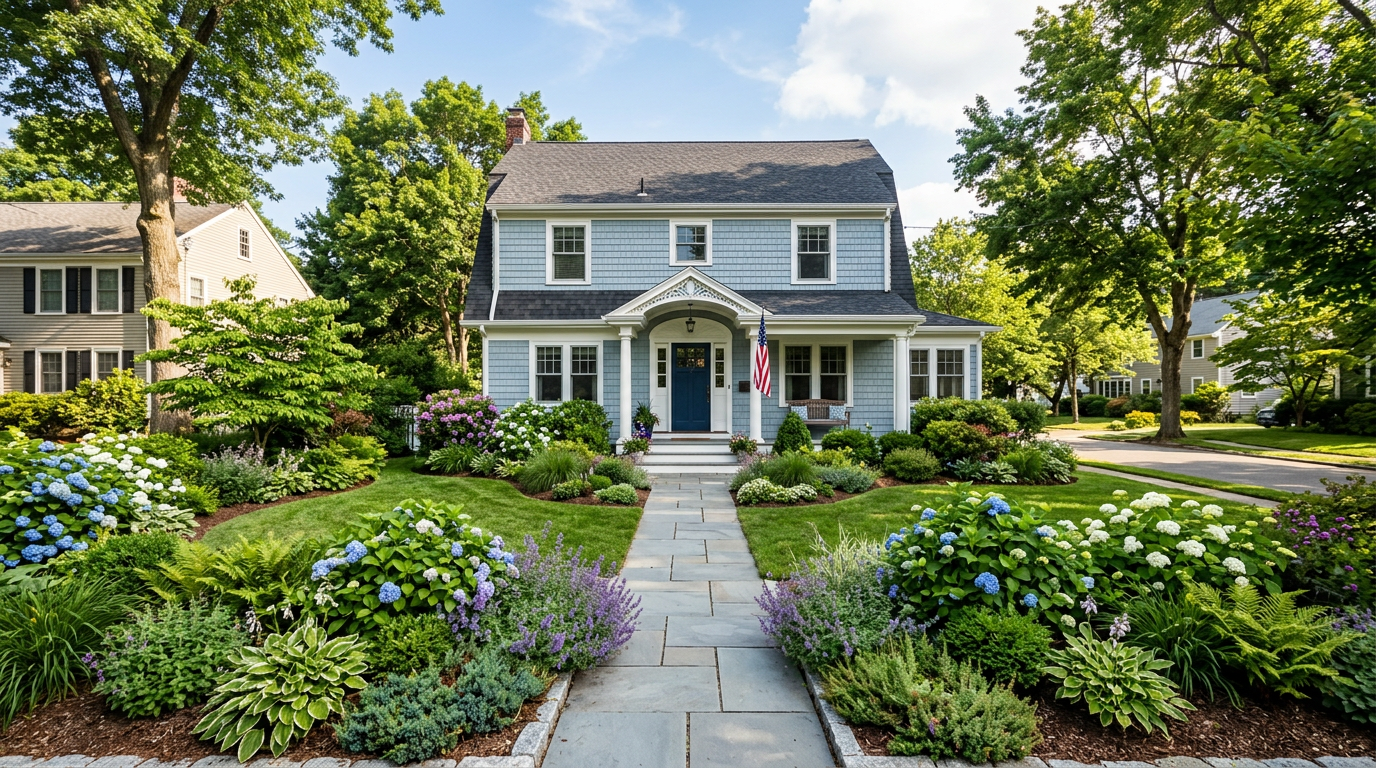
Let's be direct. Landscaping a front yard in Massachusetts is a different beast. We're not throwing down palm trees or fighting off desert heat. We're dealing with four glorious, demanding seasons, soil that’s more rock than dirt, and a historical aesthetic that doesn’t tolerate a lot of nonsense. Forget the fleeting trends you see on TV. We're here to build a classic New England front yard that looks great from the melting snows of March through the bleakest days of January, and won't require you to sell a kidney to maintain it.
This is your expert, no-gatekeeping guide to creating a functional, beautiful front yard in the Bay State. We’ll cover the plants that actually survive, the hardscaping that lasts forever, and a maintenance schedule that makes sense for our wild climate.
Foundational Choices: Mastering Massachusetts Soil and Sun
Before you buy a single plant, you have to understand your canvas. In Massachusetts, that means two things: dirt and light. Most of the state falls into USDA Hardiness Zones 5b, 6a, and 6b, with Cape Cod and the islands warming up to 7a. This means our plants need to handle winter lows that can dip well below zero.
Then there's the soil. It’s famously rocky and acidic, a souvenir from the last ice age. Don't fight it; work with it. Fighting it is expensive and exhausting. First, get a soil test. This is non-negotiable. The UMass Amherst Soil and Plant Nutrient Testing Lab offers a standard test for around $20. It will tell you your soil's pH and nutrient levels. Most MA soil leans acidic (a low pH), which is perfect for acid-loving classics like rhododendrons and azaleas, but bad for things like lawn grass, which prefers a more neutral pH. The test will tell you if you need to add garden lime to raise the pH.
Next, map your sun. Spend a day tracking how much direct sunlight different parts of your yard get.
- Full Sun: 6+ hours of direct sun.
- Part Sun/Shade: 3-6 hours of direct sun, especially morning sun.
- Full Shade: Less than 3 hours of direct sun.
Trying to grow a sun-loving Coneflower in the deep shade behind your garage is a recipe for failure. Don't do it.
The Plant Palette: Perennials & Shrubs for Massachusetts
Now for the fun part. The right plants are the ones that thrive in our specific conditions. This isn't like Arizona Desert Landscaping Ideas That Don't Suck; we need plants that can handle a deep freeze and a humid summer.
Foundation Shrubs: The Bones of Your Yard
These are the workhorses that provide structure year-round.
- Rhododendrons & Azaleas: The undisputed kings of New England. They love our acidic soil and provide spectacular spring blooms. Varieties like 'P.J.M.' Rhododendron are exceptionally hardy.
- Hydrangeas: Endless Summer® hydrangeas are a fantastic choice because they bloom on both new and old wood, meaning a late frost won't rob you of all your flowers. They're widely available at local nurseries like Mahoney's Garden Center for about $40-$60 for a 3-gallon pot.
- Inkberry Holly (Ilex glabra): A fantastic native alternative to Boxwood. It's an evergreen that doesn't suffer from the boxwood blight currently ravaging many areas. It provides great winter structure.
Tough Perennials: Color That Comes Back
Perennials die back to the ground in winter and return in spring. They are the backbone of a seasonal garden. For more ideas that work in similar climates, check out our guide to Top Midwest Perennials for Full Sun in Illinois Gardens.
- Hostas: For those shady spots where nothing else grows. 'Sum and Substance' is a giant, chartreuse variety that is incredibly tough.
- Black-Eyed Susan (Rudbeckia): A native powerhouse that blooms for months in full sun. It's cheerful, tough as nails, and feeds the birds in the fall.
- New England Aster (Symphyotrichum novae-angliae): It's in the name! This native plant explodes with purple flowers in late fall, providing a crucial late-season food source for pollinators.
- Coneflower (Echinacea): Another sun-loving champ. They come in many colors and are drought-tolerant once established.
Evergreens for Winter Structure
When the leaves fall, evergreens are what keep your yard from looking like a barren wasteland. Think of them like the furniture in a room.
- Arborvitae: 'Emerald Green' is a popular choice for privacy screens. They are tall, narrow, and relatively fast-growing.
- Eastern White Pine (Pinus strobus): Our state tree! It’s fast-growing and has a softer look than many other pines, but make sure you have the space for it.
Hardscaping the Massachusetts Way: Stone, Brick, and Granite
Hardscaping is the non-plant stuff: walls, walkways, patios, and steps. In Massachusetts, you can't go wrong with natural stone. It echoes the historical landscape of stone walls that crisscross the state.
- Stone Walls: A classic New England fieldstone wall is timeless. It can be a DIY project if you're ambitious (and have a strong back), but professional installation is often worth the cost. Expect to pay a contractor like those found in Middlesex or Essex county anywhere from $40-$75 per square face foot for a dry-stacked wall.
- Walkways & Patios: Bluestone or granite pavers are the premium choices. They look incredible and last forever. For a more budget-friendly approach, high-quality clay brick pavers offer a traditional look. We'd steer clear of stamped concrete—it can heave and crack badly during our freeze-thaw cycles and rarely looks as good as the real thing.
- Steps: If you have a slope, nothing beats solid granite steps. They are indestructible. A local supplier like Swenson Granite Works has them in standard sizes and can do custom orders. They are heavy and expensive, but you will only install them once.
Your Four-Season Massachusetts Maintenance Calendar
Landscaping here is a year-round job. Here’s a quick-and-dirty breakdown.
- Spring (March-May): The big push. Rake out leftover leaves and debris. Put a sharp edge on your beds with a spade. Apply a pre-emergent herbicide to prevent crabgrass. We prefer using corn gluten meal as a natural alternative in early spring. Top-dress beds with a 1-inch layer of good compost. We've had great results with Coast of Maine Quoddy Blend Lobster Compost (around $11 for a 1-cu ft bag at most garden centers). Then, apply a 2-3 inch layer of bark mulch to hold in moisture and prevent weeds.
- Summer (June-August): Water, weed, and enjoy. Water deeply but infrequently to encourage deep roots. Be mindful of town-wide water restrictions, which are common in July and August. Deadhead spent flowers to encourage reblooming.
- Fall (September-November): Cleanup and prep. Rake leaves (or better, mulch them with your mower). This is the best time to plant spring bulbs like tulips and daffodils. After the first hard frost, cut back your perennials. Give your lawn its final, shorter cut.
- Winter (December-February): Protect and plan. If you have delicate shrubs near a road, consider a burlap screen to protect from salt spray. Use calcium chloride or magnesium chloride ice melt on walkways near garden beds; it's less harmful to plants than standard rock salt (sodium chloride). Spend the cold days planning next year's projects.
Numbers Don't Lie: The ROI of Curb Appeal in the Bay State
Still on the fence about investing time and money? Let's talk numbers. In the hyper-competitive Massachusetts real estate market, curb appeal isn't just a nicety; it's a financial tool. The National Association of REALTORS®' 2023 "Remodeling Impact Report: Outdoor Features" found that a landscape upgrade has an estimated cost recovery of 100% upon resale. That means every dollar you spend, you're likely to get back. Furthermore, services like standard lawn care and applying mulch show an even higher ROI, often over 200%, because they create a powerful first impression of a well-maintained home. In a state where median home prices are north of $600,000, that first impression can translate to tens of thousands of dollars. (Source: https://www.nar.realtor/research-and-statistics/research-reports/remodeling-impact-report-outdoor-features)
Beyond the Basics: Edging, Lighting, and Lawn Alternatives
Ready to level up? These details make a huge difference.
- Bed Edging: A crisp edge makes everything look intentional. While plastic edging is cheap, it gets brittle and heaves out of the ground. We recommend a simple spade-cut edge (free!) or installing permanent steel edging for a clean, modern look that lasts.
- Landscape Lighting: Don't let your hard work disappear at sunset. A simple low-voltage LED lighting kit from a brand like Volt or Kichler can transform your yard. Use uplights on interesting trees and path lights along your walkway. It adds drama, and more importantly, safety.
- Lawn Alternatives: A perfect green lawn is a resource-heavy status symbol we inherited from the English aristocracy. Here in the real world, it's often a struggle. Consider reducing your lawn's footprint. Overseed with microclover for a greener, more drought-tolerant turf that feeds itself. For deep shade, cultivate a moss garden. On a sunny slope, plant creeping thyme. This is a far cry from the water-wise strategies needed for Southern California Drought Landscaping That Doesn't Suck, but it applies the same principle: use the right plant for the right place. It's a philosophy that works everywhere, from here to the Pacific Northwest Landscaping Ideas for Washington Yards.
Creating a beautiful, resilient front yard in Massachusetts is about embracing our seasons and working with our landscape's quirks. By choosing hardy, appropriate plants, investing in timeless stone, and following a logical maintenance calendar, you can build a front yard that adds value, beauty, and enjoyment to your home for decades.
Frequently asked
What is the best low-maintenance ground cover for Massachusetts?+
Creeping Thyme (for sun) and Pachysandra or Vinca Minor (for shade) are excellent low-maintenance choices. Thyme is drought-tolerant and handles foot traffic, while Pachysandra and Vinca create a dense, weed-proof green carpet in shady areas where grass struggles to grow.
How much does front yard landscaping cost in Massachusetts?+
Costs vary wildly. A simple DIY refresh with plants and mulch might be $500 - $2,000. A professional design and installation including hardscaping, like a stone walkway and new garden beds, can easily range from $7,000 to $25,000+, depending on scope and materials.
When should I plant shrubs in Massachusetts?+
The best times to plant shrubs in Massachusetts are spring (after the last frost, typically late April to May) and early fall (September to mid-October). Fall planting allows roots to establish in warm soil before winter, giving them a strong head start for the following spring.
What are the best native plants for a Massachusetts front yard?+
Top native choices include Winterberry for winter color, Inkberry Holly as a boxwood alternative, Mapleleaf Viburnum for brilliant fall foliage, and perennials like New England Aster and Black-Eyed Susan for late-season blooms that support pollinators. They are naturally adapted to local conditions.