
How to Grow Grass in Florida Sand: A No-Nonsense Guide
Growing a lush lawn on Florida's sandy soil feels impossible, but it's not. We'll show you the right grass types, soil tricks, and watering schedule to beat the sand and sun.
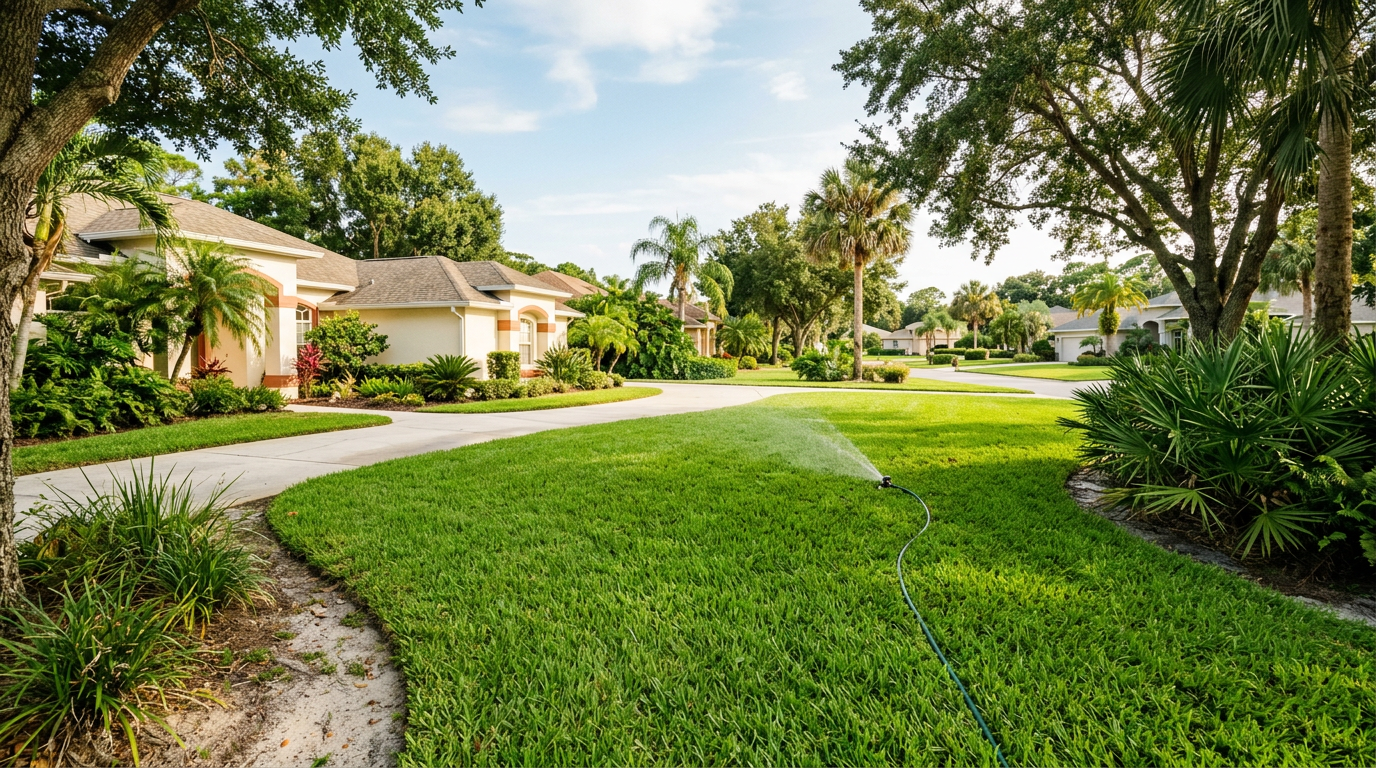
So, you want to grow a lawn in Florida. Welcome to the club. And if you're like most residents, your 'soil' is what the rest of the country uses for kid's sandboxes or to fill sandbags before a hurricane. We're talking about that fine, white 'sugar sand' that drains faster than your bank account on a trip to Disney World. Trying to grow a lush, green carpet on it feels like a fool's errand. But it’s not.
We've laid more sod on Florida sugar sand than we can count, and the single biggest mistake we see homeowners make is thinking they can just throw down some seed or sod and hope for the best. The sand will win every time. But if you're willing to do the prep work and choose your materials wisely, you can absolutely have a beautiful lawn. This is our no-nonsense guide to winning the war against sand.
Why Growing Grass in Florida Sand is So Dang Hard
Before we fix the problem, let's get real about what we're up against. Florida sand is, to be blunt, garbage for growing grass. Here’s why:
-
Zero Water Retention: It’s made of tiny particles of quartz with huge gaps between them. Water pours right through it like a sieve. This means you can water your lawn, and five minutes later, the top layer is bone dry again. The technical term is 'low water-holding capacity.' We call it 'thirsty.'
-
No Nutrients: That sand contains virtually no organic matter. Organic matter is the good stuff—decomposed leaves, microbes, and other material that holds onto nutrients like nitrogen, phosphorus, and potassium. Without it, any fertilizer you apply washes right through with the first rain or irrigation cycle, a process called leaching.
-
Compaction & Heat: While it drains well, fine sand can also become surprisingly hard and compacted on the surface, making it tough for new roots to penetrate. It also heats up like a frying pan in the Florida sun, literally cooking the delicate roots of new grass.
Understanding this trio of trouble is the first step. You aren't just planting grass; you're building a living ecosystem from scratch on a sterile base.
Step 1: Choose the Right Grass for Sandy Florida Soils
Your most important decision is your choice of grass. You can't fight the sand with a thirsty, weak-rooted variety. You need a brawler that's built for these conditions. For most of Florida, these are your top contenders.
-
Bahiagrass (Especially 'Argentine'): This is the undisputed champion for sandy, low-maintenance Florida lawns. It's not the most beautiful turf in the world, but it is tough as nails. Bahia establishes a massive, deep root system that is expert at finding water deep down. It thrives in full sun and laughs at drought. It's also the most budget-friendly option. You can get a 50 lb. bag of Pensacola Bahia seed from a local SiteOne Landscape Supply for around $160, which covers over 5,000 sq. ft. 'Argentine' Bahia offers a slightly denser, darker green look than the more pasture-like 'Pensacola' variety.
-
Zoysiagrass (Especially 'Empire'): If you want something a little more 'barefoot-friendly' than Bahia, Empire Zoysia is a fantastic choice. It has excellent drought tolerance (though not quite as bulletproof as Bahia), great salt tolerance for coastal areas, and a beautiful dark green color. It spreads with runners to create a dense mat that chokes out weeds. It's more expensive, typically only available as sod. Expect to pay a Florida sod supplier like Duda Sod or Lake Jem Farms somewhere between $250-$400 per pallet (400-500 sq. ft.).
-
St. Augustinegrass ('Floratam' or 'Bitterblue'): This is Florida's most common lawn grass, but it's a bit of a diva on pure sand. It has a very shallow root system and requires a lot of water and fertilizer to look good. We only recommend St. Augustine if you are seriously committed to amending your soil first. On unamended sand, it will struggle and become a magnet for chinch bugs and fungus. It's best suited for established neighborhoods with better topsoil.
Comparing these choices to grasses in other regions, like learning the best grass for North Carolina, highlights how geography is everything in lawn care.
Step 2: The Most Important Step – Amending Your Florida Sand
Do not skip this step. We repeat: DO NOT SKIP THIS STEP. You cannot fix sandy soil by sprinkling something on top. You have to fundamentally change its composition by tilling in massive amounts of organic matter.
Your goal is to create a 6- to 8-inch deep layer of improved soil. To do this, you need to add 3 to 4 inches of compost on top of your existing sand and then till it all together.
-
Get the Good Stuff: You need compost. Lots of it. For a small area, bagged products work. Black Kow Composted Cow Manure is a Florida staple and costs about $7 per 1 cu. ft. bag at Home Depot or Lowe's. For a whole lawn, buying in bulk is the only way to go. Look for local landscape suppliers or even municipal recycling centers. A company like Recycled KPL in the Orlando area or a local landscape supply yard will sell bulk compost for about $30-$45 per cubic yard. You'll likely need several yards.
-
Spread it Out: Lay down a solid 3-4 inch layer of compost over the entire area you plan to plant.
-
Mix it In: This is the hard part. You need to rent a rear-tine tiller. Don't cheap out with a small cultivator; you need power. Rent one from a local big-box store for about $80-$100 a day. Set the tilling depth to at least 6-8 inches and go over the entire lawn area two or three times, mixing the compost deep into the sand. It should look like dark, rich soil when you're done, not sand with some black stuff on top.
This process is the single greatest investment you can make in your Florida lawn's future success.
Step 3: Seeding vs. Sodding Your New Lawn
With your soil prepped, it's time to plant. You have two choices:
-
Sodding: This gives you an 'instant lawn.' It's more expensive but provides immediate soil cover, which is a huge advantage on sand. The sod itself helps retain moisture and prevents your expensive compost from washing away in the first afternoon thunderstorm. Installation is straightforward: lay the pieces tightly together like bricks, stagger the seams, and water, water, water.
-
Seeding: This is far cheaper but requires more patience and care. Bahiagrass is almost always grown from seed. The challenge is keeping the seed moist enough to germinate in fast-draining sand. You'll need to water lightly multiple times a day for the first few weeks. Spreading a very thin layer of peat moss or compost over the seed can help hold in moisture.
For sandy sites, we lean towards sod if the budget allows, simply because it stabilizes the site immediately. If you're seeding, be prepared to be vigilant with your watering.
Step 4: Master the Watering Schedule for a Florida Sandy Soil Lawn
How you water is just as important as what you plant. The common mistake is shallow, frequent watering. This teaches the grass to keep its roots in the top inch of soil, where they will fry in the sun. You need to teach it to be tough.
The rule is deep and infrequent watering.
-
How much? Apply about ¾ to 1 inch of water per session. A simple way to measure this is to place a few empty tuna cans around your lawn. Time how long it takes for your sprinkler to fill them to the 1-inch mark. That's your run time.
-
How often? During establishment (the first month), you'll water every day. But after that, you cut back. For established lawns on amended sand, you should only need to water 1-2 times per week during the hottest, driest parts of the year. In the cooler months, you might go a week or more without irrigating. This forces the grass roots to dive deep into the soil searching for moisture, making the lawn far more drought-tolerant.
Be sure to follow local regulations. Most of Florida is under some form of watering restriction, managed by districts like the St. Johns River Water Management District (SJRWMD) or South Florida Water Management District (SFWMD), which typically limit watering to two days a week. Our detailed Florida Lawn Care Schedule breaks this down by season.
Step 5: Fertilizing and Long-Term Care
Because sandy soil loves to leach nutrients, your fertilization strategy needs to be smart. According to the University of Florida IFAS Extension, many native Florida soils are over 95% sand with less than 2% organic matter, making them notoriously poor at retaining water and nutrients necessary for healthy turf. (Source: https://edis.ifas.ufl.edu/ss554)
First, get a soil test from your county's UF/IFAS Extension office. It costs about $10 and is the only way to know what your soil actually needs.
When you do fertilize, use a slow-release product. These coated granules release nutrients over weeks or months instead of all at once, which prevents them from washing right through the sand. Milorganite is a popular choice; it’s an organic-based, slow-release nitrogen fertilizer that is very difficult to 'burn' your lawn with. Apply it according to the bag directions about 3-4 times during the active growing season (typically March through October). Mowing high (3-4 inches) also encourages deeper roots and helps shade the soil, keeping it cooler and moister.
Growing grass in Florida sand is a challenge, but it's a solvable one. It's less about gardening and more about construction. You are literally building a better foundation. Do the heavy lifting upfront by amending the soil, choose a tough grass like Bahia, and adopt a smart watering schedule. You'll spend less time and money fighting your lawn and more time enjoying it.
Frequently asked
What is the best grass seed for sandy soil in Florida?+
Bahiagrass, especially the 'Argentine' variety, is the best overall choice for its deep roots and extreme drought tolerance on sandy Florida soils. It requires less water and fertilizer than other types like St. Augustine or Zoysia, making it a low-maintenance champion.
Can you just put topsoil over sand to grow grass?+
No. Simply layering topsoil over sand creates a drainage barrier and stops roots from growing deep. You must thoroughly mix or till at least 3-4 inches of quality compost or topsoil *into* the top 6-8 inches of existing sand for a healthy, deep-rooted lawn.
How do you keep grass green in Florida sand?+
Keep grass green in sand by watering deeply (1 inch) but infrequently (1-2 times per week), using a slow-release fertilizer like Milorganite every 2-3 months during the growing season, and mowing high (3-4 inches) to encourage deep roots and shade the soil.
Is St. Augustine grass good for sandy soil?+
While common in Florida, St. Augustine grass is less tolerant of pure, unamended sandy soil than Bahiagrass. It has high water and nutrient needs due to its shallow roots, making it a high-maintenance choice for sandy lots without significant soil improvement first.
How much does it cost to amend sandy soil in Florida?+
Costs vary. Bagged compost like Black Kow is about $7 per 1 cu. ft. bag. For larger areas, bulk compost from a Florida landscape supplier can run $30-$45 per cubic yard, plus delivery fees. Renting a tiller can cost an additional $80-$100 per day.