
Fall Lawn Fertilizer Schedule: A No-Nonsense Guide
Stop guessing your fall lawn fertilizer schedule. We'll break down exactly when and what to feed your lawn for winter survival and a spectacular spring green-up.
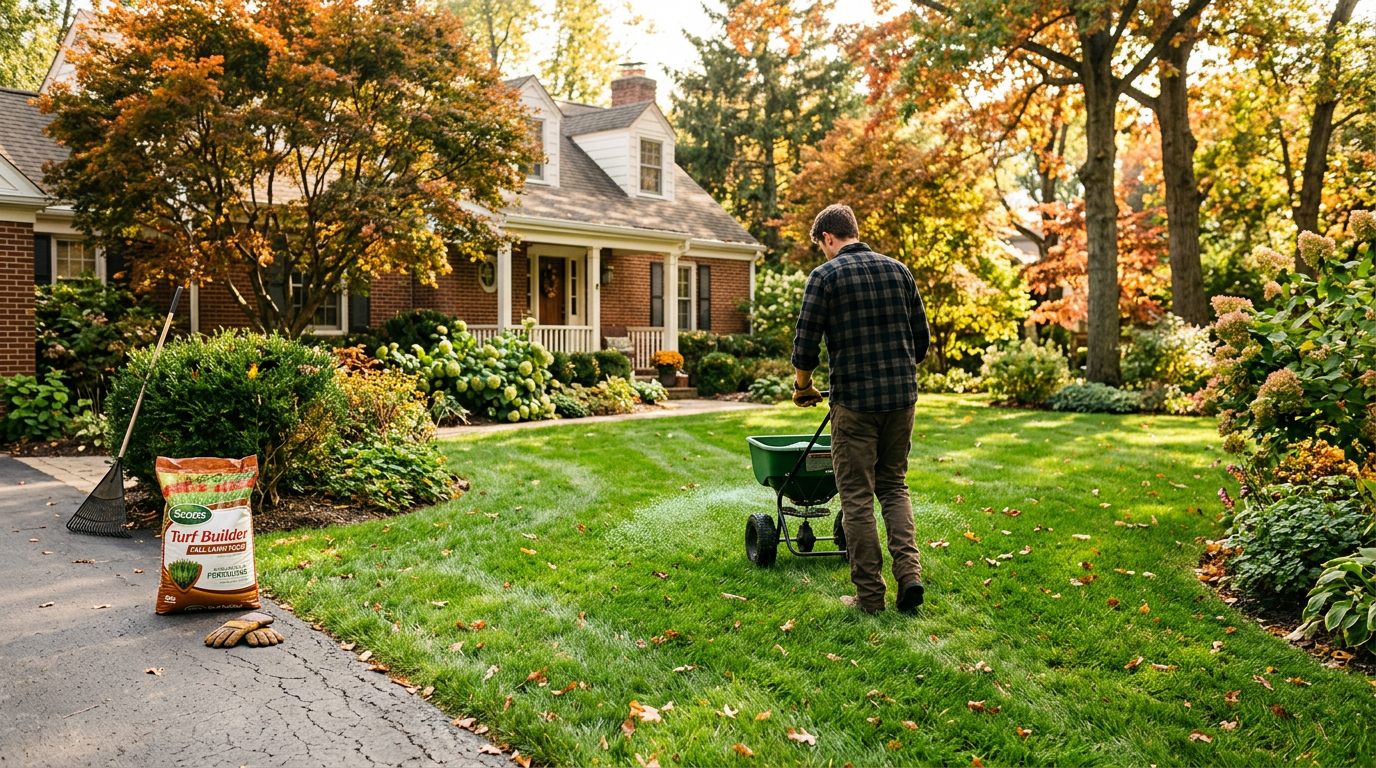
If you do only one thing for your lawn all year, it should be fertilizing in the fall. Seriously. Forget the manic need for a green-up in April. The work you do in autumn is what separates the lush, dense turf from the patchy, weedy messes we see every spring.
Most people think of fertilizer as food for green growth. In the fall, that's only half the story, and it's the less important half. Fall fertilizing is about setting your lawn up for a long, cold winter and giving it the underground foundation it needs to explode with healthy growth next year. It's not a final sprint; it's carbo-loading for a marathon.
We're here to cut through the noise and give you a straightforward, actionable fall lawn fertilizer schedule. No gatekeeping, no vague advice. Just what to do, when to do it, and why.
Why Fall Fertilizer is a Non-Negotiable
The magic of fall lawn care happens below the surface. As the air temperature cools down, your grass's top growth naturally slows. But the soil is still relatively warm from the summer sun. This combination—cool air, warm soil—is the VIP signal for roots to go into overdrive.
Instead of pushing out new blades of grass, the plant diverts its energy downward, growing and strengthening its root system. A deep, dense root system is the entire ballgame. It's what helps your lawn:
- Survive winter: Strong roots store carbohydrates (sugars) that act as an energy reserve to get through freezing temperatures and dormancy.
- Resist drought: Deeper roots can access moisture further down in the soil profile when the summer heat returns.
- Choke out weeds: A thick, healthy lawn leaves no room for crabgrass and other invaders to get a foothold next spring.
- Green up faster: A lawn with a well-fed root system is ready to launch the moment spring conditions are right, often weeks before unfed lawns.
Your fall fertilizer applications provide the fuel for this critical root-building phase. Skipping it is like sending a soldier into winter battle without a coat or rations.
The “When” Game: Timing Your Fall Fertilizer Applications
"Fall" is a three-month season. You can't just throw down fertilizer any old time in September and call it a day. The timing is specific, and for many lawns, it's a two-step process. The key is to pay attention to soil temperatures, which you can easily check with a simple soil thermometer (about $10 online).
Application 1: Early Fall (Labor Day to Mid-October)
This first feeding is for cool-season grasses that are actively recovering from the stress of summer. Think of this as the recovery meal. The ideal window is when daytime temperatures are consistently in the 70s and soil temperatures drop below 70°F.
- Who it's for: Primarily cool-season grasses (more on this below).
- What it does: Replenishes nutrients used up during summer and fuels both root and top growth while the grass is still actively growing.
- Perfect Pairing: This is also the absolute best time for aeration and overseeding. If your lawn is looking thin, aerating and then putting down seed and a starter fertilizer is the ultimate fall combo. For a full breakdown, check our guide on when to overseed your lawn in fall.
Application 2: Late Fall / "Winterizer" (Late October to Thanksgiving)
This is the most important fertilizer application of the entire year. You'll apply this when the grass has mostly stopped growing on top, but before the ground freezes solid. This usually means you've had a light frost or two and your mowing season is over for the year.
- Who it's for: Cool-season grasses only. Do not do this on warm-season grasses.
- What it does: This application isn't for green top growth. It's a direct deposit into the root system's energy bank. The roots, which stay active longer than the blades, soak up these nutrients and store them for winter. This is what powers that impressive, early spring green-up.
Cool-Season vs. Warm-Season Grass: A Tale of Two Schedules
There is no one-size-fits-all schedule. What's perfect for a lawn in Massachusetts is a terrible idea for a lawn in Florida. It all comes down to your grass type.
Cool-Season Grasses (Kentucky Bluegrass, Fescues, Ryegrass)
If you live in the northern half of the country, from New England across the Midwest and into the Pacific Northwest, you likely have cool-season grass. For you, fall is prime time. Your schedule is the two-step process we just outlined:
- Early Fall Feeding: Apply a balanced, nitrogen-rich fertilizer between Labor Day and mid-October.
- Late Fall Winterizer: Apply a potassium-rich winterizer fertilizer between late October and Thanksgiving, after top growth has stopped but before the ground freezes.
This one-two punch ensures your lawn recovers from summer and is fully charged for winter.
Warm-Season Grasses (Bermuda, Zoysia, St. Augustine, Centipede)
If you're in the South and Sun Belt, from the Carolinas down through Florida and across to Texas, you have warm-season grass. Your lawn is getting ready to go dormant for the winter, and your fertilizing strategy must reflect that.
- Early Fall Feeding: A light application of fertilizer in September can be beneficial if the lawn is still actively growing. Use a product with low nitrogen or switch to a potassium-focused feed.
- NO LATE FALL FERTILIZER: Do not apply a "winterizer" or any nitrogen-heavy fertilizer to warm-season grass in late fall. It can encourage a flush of tender new growth that the first hard frost will immediately kill. This wastes the plant's energy reserves and can leave it vulnerable to disease.
For warm-season lawns, your last significant nitrogen feeding should have been in late summer. In fall, the focus is on winding down, not gearing up. You can apply a high-potassium fertilizer in fall to boost root hardiness, but go light on the nitrogen.
Reading the Bag: Decoding N-P-K for Fall
Those three numbers on the fertilizer bag (N-P-K) are your roadmap. They represent the percentage by weight of Nitrogen (N), Phosphorus (P), and Potassium (K).
- Nitrogen (N): Promotes vigorous, green top growth.
- Phosphorus (P): Essential for root development and energy transfer. Often restricted in many areas, so you'll see it as a '0'.
- Potassium (K): The powerhouse for overall plant health. It regulates internal processes, improves stress tolerance, and strengthens cells against cold and disease.
For fall applications, Potassium is the MVP. According to the University of Minnesota Extension, potassium "is associated with the plant’s ability to withstand stress, including drought, heat, cold and disease pressures." (Source: https://extension.umn.edu/lawn-care/fertilizing-lawns) It's the nutrient that hardens the plant for winter.
Here's what to look for:
- Early Fall Fertilizer (Cool-Season): A balanced fertilizer works well here. Look for something like The Andersons PGF Complete 16-4-8 (around $65 for 10,000 sq. ft.) or a simple big-box brand with numbers like 24-0-6.
- Late Fall Winterizer (Cool-Season): This is where you want high Potassium. We've seen it a thousand times: a lawn fed a high-nitrogen mix in late November gets a flush of weak growth that a hard frost turns to mush. Stick with the high-potassium winterizer formula; it's what the turf actually needs. Look for a product specifically labeled "Winterizer," like Scotts Turf Builder WinterGuard Fall Lawn Food (approx. $25 for 5,000 sq. ft.) or a similar product with an N-P-K ratio where the K is high, like 12-0-18.
The Right Tools and Technique
You don't need a pro-level rig. A simple broadcast (rotary) spreader is perfect for 99% of homeowners. It throws granules in a wide arc, making coverage fast and even. We like the Scotts Turf Builder EdgeGuard Mini Broadcast Spreader (about $40) for a reliable, affordable option.
Your technique matters more than the tool:
- Read the Bag: Look for the correct spreader setting for your specific model. If your model isn't listed, start low and make a test pass on a tarp to see the coverage.
- Calibrate: Don't just trust the numbers. A 5,000 sq. ft. bag should cover... 5,000 sq. ft. If you run out after 3,000, your setting is too high. If you have half a bag left, it's too low.
- Walk a Straight Line: Walk at a steady, consistent pace. Don't stop and start with the spreader open.
- Overlap Correctly: To avoid stripes, overlap your passes. Most spreaders require you to overlap so the edge of your current pass hits the wheel tracks from your previous pass.
- Clean Up: Sweep or blow any stray granules from your driveway, sidewalk, or street back onto the lawn. Fertilizer in waterways is a major pollutant.
Your Lawn's Spring Body is Built in the Fall
Let's put it simply. The effort you put into your lawn this fall directly determines how it looks next spring. A couple of well-timed fertilizer applications are the best investment you can make in your turf.
For cool-season grass owners, hit it with a balanced feed in early fall and a high-potassium winterizer before the ground freezes. For warm-season grass owners, a light potassium feed in early fall is your last step before letting the lawn go to sleep for the winter.
This isn't complicated. You don't need a degree in agronomy. You just need the right schedule, the right bag, and an hour on a crisp autumn afternoon. Get it done, and your lawn will thank you next April.
Frequently asked
Can I fertilize my lawn in October?+
Yes, October is a prime month. For cool-season grass, it's perfect for either an early-fall balanced feeding or a late-fall 'winterizer' application, depending on your location and the weather. For warm-season grass, a light feeding in early October is the last call before dormancy.
What is the best type of fertilizer for fall?+
For early fall, a balanced fertilizer like a 24-0-6 is great. For late fall (the "winterizer" application on cool-season grass), the best choice is a fertilizer high in potassium (the 'K' in N-P-K), such as a 12-0-18 formula, to boost root health and cold tolerance.
What happens if I fertilize my lawn too late in the fall?+
Fertilizing too late, especially with high nitrogen, can force new, weak top growth that will be damaged by the first hard frost. This wastes the plant's energy reserves and can make it more susceptible to winter diseases. It's especially harmful for warm-season grasses entering dormancy.
Is it better to fertilize in spring or fall?+
While both are important, fall is arguably more critical. Fall fertilization builds strong roots and stores energy for winter, leading to a healthier, greener lawn in the spring with fewer weeds. Spring feeding is more about supporting that initial burst of growth created by fall prep.