
Arizona Desert Landscaping Ideas That Don't Suck
Stop fighting the Arizona desert and start working with it. We’re breaking down the best, no-nonsense landscaping ideas that actually look good and won't bankrupt you on your water bill.
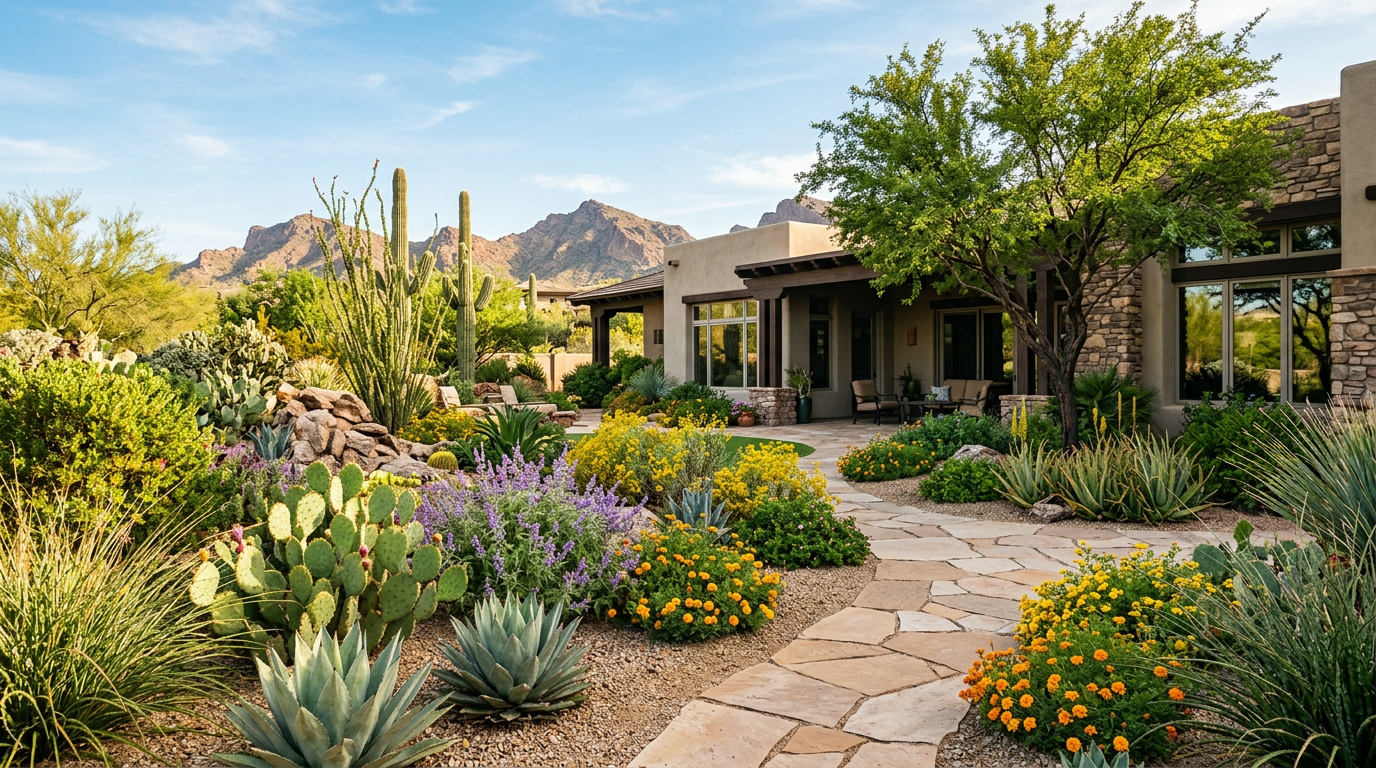
Let's be direct. Trying to force a lush, green, East Coast lawn in the middle of Arizona is a fool's errand. We've seen it a thousand times: someone moves to Phoenix or Tucson, spends a fortune on sod, and then watches it turn into a crispy, brown monument to a sky-high water bill by July. It's time to stop fighting the Sonoran Desert and start embracing it. The secret to a stunning yard here isn't about defeating nature; it's about smart design, the right plants, and a little bit of expert know-how.
We're not talking about a yard full of sad, lonely cacti and a sea of boring gravel. We're talking about creating a vibrant, functional, and jaw-droppingly beautiful outdoor space that works with the Arizona climate, not against it. This guide is your no-nonsense roadmap to achieving a desert landscape that saves water, boosts your curb appeal, and actually makes you want to spend time outside—even when it's 110°F.
Forget the Lawn: Why Xeriscaping is King in Arizona
First, let's clear something up. Xeriscape does not mean "zero-scape." It's not about eliminating plants; it's about choosing the right ones and putting them in the right place to minimize water use. It’s the single most important concept for landscaping in Arizona, and mastering it is the key to success. Think of it as a design philosophy with seven core principles: planning, soil improvement, appropriate plant selection, practical turf areas (meaning, very small or none at all), efficient irrigation, mulching, and maintenance.
Why does it matter so much here? Water. Or, the lack of it. According to the Arizona Municipal Water Users Association (AMWUA), a typical grass lawn in the Phoenix area can guzzle over 30,000 gallons of water per 1,000 square feet annually. A well-designed xeriscape can slash that usage by 70% or more. (Source: https://www.amwua.org/plants/xeriscape-plans) This isn't just an environmental platitude; it's a direct saving on your monthly budget. Many Arizona cities will even pay you to do it. The City of Scottsdale's Water Department, for example, offers a rebate for removing grass and converting to desert-friendly landscape. Check your local municipality's website; you could get paid to save money.
This isn't a new concept, and it's not unique to our state. Homeowners dealing with similar challenges have found huge success with Southern California Drought Landscaping That Doesn't Suck. The principles are universal: work with your climate, not against it.
The Unbeatable Plant Palette for Your Arizona Garden
This is where the fun begins. Choosing the right plants turns your yard from a patch of dirt into a living ecosystem. Forget the finicky imports; we're using native and desert-adapted species that thrive in our intense sun and alkaline soil. You can find an incredible selection at local nurseries like Moon Valley Nurseries (multiple locations) or A&P Nursery in the Phoenix metro.
Foundational Trees for Shade and Structure
Shade is a non-negotiable commodity. A well-placed tree can lower ambient temperatures by 20 degrees and reduce your home's cooling costs.
- Palo Verde (Parkinsonia spp.): The state tree! Both Blue and Foothills Palo Verde are fantastic choices. Their green bark photosynthesizes, their yellow spring flowers are spectacular, and they provide light, filtered shade that allows other plants to grow underneath. A 15-gallon tree will run you about $100-$150.
- Desert Willow (Chilopsis linearis): Not a true willow, but its beautiful, trumpet-shaped flowers (in white, pink, or burgundy) bloom all summer long. It's fast-growing and incredibly tough.
- Ironwood (Olneya tesota): A slower-growing but incredibly dense and long-lived tree. It's a true Sonoran Desert native that creates deep shade and has beautiful lavender flowers in late spring.
Cacti and Succulents for Form and Drama
No Arizona landscape is complete without them. We're not just sticking a single saguaro in the corner; we're using them as sculptural elements.
- Saguaro (Carnegiea gigantea): The icon. Be aware: they are protected. Never move or transplant one without the proper permits from the Arizona Department of Agriculture. It's often easier to design around existing ones or buy nursery-grown specimens.
- Agave (Agave spp.): Dozens of varieties work here. The Parry's Agave (Agave parryi) offers a tight, artichoke-like form, while the Octopus Agave (Agave vilmoriniana) provides wild, arching leaves.
- Golden Barrel Cactus (Echinocactus grusonii): Fantastic when planted in groups of three or five. They provide a perfect, modern-looking globe of color and texture.
Shrubs and Perennials for Color and Texture
This is your supporting cast, filling in the gaps with year-round color.
- Texas Sage (Leucophyllum frutescens): This silver-leafed shrub explodes in a riot of purple flowers after summer rains. It's practically indestructible.
- Yellow Bells (Tecoma stans): A large shrub or small tree that produces masses of bright yellow, trumpet-shaped flowers from spring through fall.
- Red Yucca (Hesperaloe parviflora): Technically not a yucca, but its long, slender leaves and tall stalks of coral-pink flowers are a magnet for hummingbirds.
Hardscaping for the Arizona Heat: Ground Cover and Structures
Hardscape is the bones of your landscape—the patios, paths, and walls that define the space. In Arizona, it's just as important as the plants.
Ground Cover: The biggest decision you'll make after ditching the lawn is what to replace it with. Our top choice is Decomposed Granite (DG). It's natural, permeable (allowing rainwater to soak in), and comes in various colors like 'Gold' and 'Pewter' to complement your home. It's also cost-effective. You can expect to pay around $50-$70 per ton, and one ton covers roughly 100-120 square feet at a 2-inch depth. We prefer it over landscape rock (which can create a 'heat island' effect) or bark (which decomposes quickly and can be a fire hazard).
Patios and Paths: For walkways and patios, use materials that don't become blast furnaces in the sun. Lighter-colored travertine pavers are an excellent, though pricey, choice because they stay cooler than concrete or darker slate. Flagstone set on a DG base provides a more rustic, informal look that blends seamlessly with the desert environment.
Shade Structures: Sometimes a tree isn't enough. A well-designed ramada, pergola, or even a simple shade sail can create a comfortable outdoor room. We've seen incredible results using modern steel-framed pergolas with weather-resistant wood slats. This creates a functional living space where you can actually sit in August.
Water Wisely: Smart Irrigation for the Arizona Desert
Your beautiful new plants will die without water, but how you deliver it is crucial. Sprinklers are out. In our dry air, up to 50% of the water from a sprinkler can evaporate before it even hits the ground. The only answer is drip irrigation.
A drip system delivers water slowly and directly to the root zone of each plant. This encourages deep, strong roots and minimizes water loss to evaporation and runoff. You can DIY a system for a small yard for a few hundred dollars. We often recommend the Rain Bird Drip Irrigation Starter Kit, which you can get for about $40 at any big box store, as a good entry point.
Connect your system to a smart controller like the Rachio 3 ($200-$250). These Wi-Fi enabled controllers pull local weather data and automatically adjust watering schedules based on temperature, humidity, and rainfall, taking all the guesswork out of it. It’s the single best upgrade you can make to your irrigation system. Proper watering is a universal theme in tough climates, from our desert to the Rockies, where they also have specific Landscaping Ideas for Colorado That Actually Work.
Light It Up: Desert Landscape Lighting for Nighttime Magic
Just because the sun goes down doesn't mean your yard has to disappear. In fact, for half the year, evenings are the best time to be outside in Arizona. Landscape lighting transforms your yard into a 24-hour space.
Focus on a few key techniques:
- Uplighting: Place a spotlight at the base of a feature tree like a Palo Verde or Ironwood. It highlights the trunk structure and creates a dramatic silhouette.
- Path Lighting: Low-profile lights along walkways ensure safety without creating light pollution.
- Wash Lighting: Use a wide-beam light to softly illuminate a textured wall or a bank of interesting shrubs.
We exclusively use low-voltage LED systems. They are energy-efficient, safe to install yourself, and the bulbs last for years. A high-quality starter kit from a brand like VOLT Lighting might cost between $300 and $500, but it’s a worthy investment for the ambiance and usability it adds. While our friends are dealing with their St. Augustine, as seen in this Texas Lawn Care Seasonal Guide, we're enjoying a cool drink in our perfectly lit desert oasis.
Putting It All Together: Your Arizona Landscape Plan
Creating the perfect Arizona desert landscape is a journey, not a weekend project. Start with a plan. Sketch out your yard, identify sunny and shady zones, and decide where you want patios, paths, and seating areas. Phase your installation. Maybe you tackle the irrigation and hardscaping one season, and then add the trees and major shrubs the next.
Don't be intimidated. By choosing the right plants, embracing hardscape, and watering wisely, you can create a landscape that is not only beautiful and sustainable but is a true reflection of the stunning Arizona environment. You've got this.
Frequently asked
What is the cheapest desert landscaping idea for Arizona?+
Decomposed granite (DG) ground cover combined with a few strategically placed native plants is the most budget-friendly option. DG runs about $50-$70 per ton, and young native plants are inexpensive. This minimizes water use and maintenance costs immediately.
How do I keep my Arizona backyard cool?+
Create shade. Plant deciduous trees like Desert Willow or Palo Verde on the west and south sides of your yard. Install a ramada, pergola, or shade sails over patios. Light-colored pavers and ground cover also reflect heat better than dark materials.
Can I have a lawn in Arizona?+
You can, but we strongly advise against it due to extreme water usage. If you must have grass, choose a drought-tolerant variety like Bermuda grass for a very small, functional area. Many cities offer rebates for removing turf grass entirely.
What are the best low-maintenance plants for Phoenix?+
For truly 'set-it-and-forget-it' plants in Phoenix, look to Texas Sage, Red Yucca, Brittlebush, and various Agave species. Once established, they require minimal water outside of natural rainfall and thrive in the intense summer heat and sun.