
Real Arizona Desert Landscaping Ideas That Actually Work
Stop fighting the desert and start working with it. Here are our best, no-nonsense tips for creating a stunning, low-water landscape that can handle the Arizona heat.
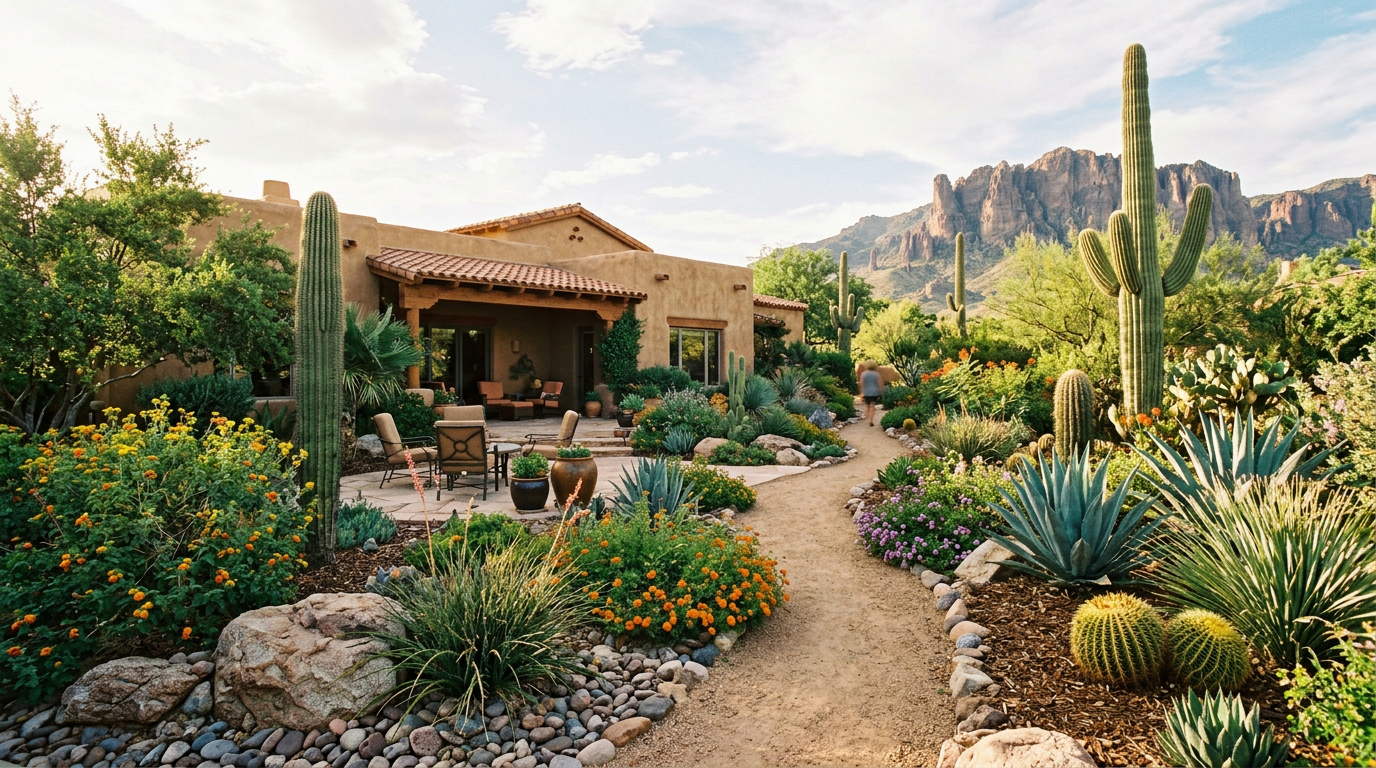
Let's get one thing straight: A great Arizona landscape is not a sea of beige gravel with three sad-looking cacti. We live in one of the most unique and beautiful ecosystems on the planet—the Sonoran Desert. Fighting it by trying to grow a Kentucky bluegrass lawn is a fool's errand that costs a fortune in water and sweat. The real genius lies in working with the Arizona climate to create a yard that's not just alive, but bursting with color, texture, and life.
We're here to show you how to move beyond the stereotypical 'desert' look and build a functional, stunning, and water-wise outdoor space. This isn't about deprivation; it's about intelligent design using the right materials and plants that were literally born for this.
Why ‘Xeriscaping’ Isn't Just a Pile of Rocks in Arizona
The word is 'Xeriscaping,' not 'Zeroscaping.' It’s a term that gets thrown around a lot, and most people get it wrong. It doesn't mean no plants and no water. It means designing a landscape that minimizes the need for supplemental irrigation. Here in Arizona, that's not just a good idea—it's essential.
A well-designed xeriscape is vibrant. It’s about creating a layered, textured look. Think sculptural agaves, feathery palo verde trees, and seasonal explosions of color from penstemons and desert marigolds. It’s about attracting hummingbirds and butterflies instead of high water bills.
According to the Arizona Department of Water Resources, outdoor water use can account for up to 70% of a household's total water consumption. Switching from a traditional lawn to a well-designed desert landscape can reduce that outdoor use by over 50%, saving thousands of gallons—and hundreds of dollars—annually. (Source: https://new.azwater.gov/conservation/water-use-it-wisely)
So, let's ditch the notion that low-water means low-impact. The goal is a high-impact look with a low-impact resource footprint.
The Foundation: Hardscaping Your Arizona Yard for Success
Before you plant a single thing, you need to think about your hardscape. This is the non-living backbone of your yard: the patios, walkways, and groundcovers that define the space. In Arizona, your hardscape is arguably more important than your plants.
We've installed countless yards in the Valley, and the biggest mistake we see is underestimating the power of good hardscaping. It's what makes a yard usable when it's 110°F in the shade.
Here are your key players:
- Decomposed Granite (DG): This is your workhorse. It's a fine, crushed rock that packs down tightly to create a stable, natural-looking surface for paths and seating areas. It's permeable, allowing precious rainwater to soak into the ground. A ton of DG from a local supplier like Pioneer Sand or AZ Rock will run you about $50-$80 and covers roughly 80-100 sq. ft. at a 2-inch depth.
- Pavers and Flagstone: For high-traffic areas like patios and main walkways, you can't beat pavers or natural flagstone. They create a solid, level surface that's perfect for outdoor furniture. Pavers can cost anywhere from $3 to $8 per square foot for the material, while flagstone is often sold by the ton. Use them to create a destination—a place to put your grill, a fire pit, or a dining table.
- Shade Structures: A ramada, pergola, or even a simple shade sail is not a luxury in Arizona; it's a necessity. Placing one on the west or south side of your house can dramatically cool your outdoor space and even lower your home's air conditioning bills. It extends your living space and makes the outdoors tolerable for more than two months of the year.
Picking the Right Plants for the Arizona Climate (That Aren't Just Cacti)
Okay, now for the fun part. While our neighbors in more temperate climates are wrestling with different challenges, like those you might find in landscaping ideas for Colorado, our primary battle is with heat and sun. The key is choosing plants adapted to the Sonoran Desert. And no, they're not all spiky.
Here’s our no-nonsense list, broken down by function:
Trees for Essential Shade
- Palo Verde ('Desert Museum' is the best): The state tree for a reason. It has a beautiful green trunk, a light, filtered shade that won't kill everything underneath it, and a spectacular yellow bloom in the spring. It's fast-growing and tough as nails.
- Desert Willow: Don't let the name fool you; it's not a true willow. This small-to-medium tree has narrow leaves and produces gorgeous, trumpet-shaped flowers all summer long that hummingbirds go crazy for. It's incredibly drought-tolerant once established.
- Ironwood: A slower-growing but incredibly dense and hardy tree. It provides deep shade and has a lovely lavender bloom in early summer. This is a long-term investment in your landscape's comfort.
Shrubs and Perennials for Color & Texture
- Red Bird of Paradise (Caesalpinia pulcherrima): This is your showstopper. From May to October, it's covered in brilliant red and orange flowers. It loves the full, brutal Arizona sun and thrives on neglect.
- Texas Sage (Leucophyllum frutescens): This shrub is a living barometer. It explodes in a riot of purple flowers after a drop in humidity, often right before a monsoon storm. Its silvery foliage is a beautiful contrast against other green plants.
- Lantana: If you want bulletproof color, get Lantana. It comes in a dozen colors, blooms nearly year-round, attracts butterflies, and can handle being blasted by heat reflected off a block wall. A one-gallon plant from a nursery like Moon Valley runs about $10-$15.
Sculptural Accents & Groundcovers
- Agave: The kings of desert sculpture. A single, well-placed Artichoke Agave (Agave parryi var. truncata) can be the focal point of an entire garden bed. Just be sure to plant them away from walkways!
- Red Yucca (Hesperaloe parviflora): This isn't a true yucca, but it's one of the most useful plants in desert landscaping. It has grass-like leaves and sends up tall spikes of pinkish-red flowers that last for months. It needs zero care.
- Trailing Verbena: Need to cover some ground? Trailing verbena varieties will cascade over walls and fill in spaces with a carpet of purple flowers. It's a great way to soften the edges of all that rock and DG.
Water-Wise Irrigation: The Secret Weapon
Your amazing new plants will die without a smart watering strategy. Forget sprinklers that spray water into the air where it evaporates instantly. In Arizona, we use drip irrigation. Period. While folks in other regions might be focused on Texas lawn care seasonal guides, our focus is precision water delivery.
A drip system uses a network of tubing to deliver water directly to the root zone of each plant. For shrubs and perennials, you'll use small emitters (0.5 to 2 gallons per hour). For trees, you'll use dedicated bubblers or multiple emitters to ensure deep watering. We’re big fans of Netafim's pressure-compensating dripline for its reliability.
The most important concept here is hydrozoning. This is a fancy word for a simple idea: group plants with similar water needs together. Don't plant a thirsty bougainvillea right next to a bone-dry agave. By creating zones—a tree zone, a shrub zone, a low-water succulent zone—you can program your irrigation controller to give each area exactly what it needs and nothing more. This is how you achieve those massive water savings.
Putting It All Together: A Sample Arizona Desert Design
Let's imagine a typical front yard in Phoenix, Scottsdale, or Tucson. It's a rectangle facing south.
- Anchor with Shade: Plant a 'Desert Museum' Palo Verde about 15 feet out from the southwest corner of your house. This will start shading your wall and window in a few years, cutting A/C costs.
- Create a Destination: Use pavers or flagstone to create a small, 10'x10' patio area near your front door, extending your entryway. This gives you a place for a bench and some pots.
- Define with DG: Use decomposed granite for the rest of the yard, creating gentle curves for walkways that lead from the driveway to the front door and patio.
- Layer in the Mid-story: Along the foundation and property lines, plant clusters of Texas Sage and Red Bird of Paradise. This breaks up the flat expanse and adds height and privacy.
- Add the Bling: Place a single, large Agave or a group of three Red Yuccas as a focal point in a prominent spot. This is your art piece.
- Fill the Gaps: Use trailing lantana and verbena along the edges of the paver patio and walkways to soften the hard lines and provide continuous color.
This basic formula—similar in principle to what works in Southern California drought landscaping but with our own unique plant palette—creates a landscape with depth, function, and year-round interest.
Building a beautiful Arizona landscape is a rewarding process. It connects you to the place you live and proves that you can have a stunning yard that is also a responsible one. Now go get your hands dirty.
Frequently asked
How much does Arizona desert landscaping cost?+
Costs vary wildly. A DIY refresh with plants and mulch might be $500-$2,000. A full professional overhaul with hardscaping, irrigation, and large plants can range from $10,000 to $30,000+. Decomposed granite is about $50-$80/ton, while mature trees cost several hundred dollars each.
What is the best rock for Arizona landscaping?+
Decomposed granite (DG) is the most popular and versatile choice, available in colors like gold and gray. For accents, consider 1/2-inch to 1-inch river rock or Madison Gold. Avoid using just one type of rock; mix sizes and colors for a more natural look.
Can I have a lawn in Arizona?+
Yes, but it's a commitment. Many people opt for small patches of heat-tolerant Bermuda grass, but water and maintenance costs are high. Many HOAs and cities now offer rebates for removing turf. Consider high-quality artificial turf as a low-water alternative for small areas.
What are the easiest plants for Arizona desert landscaping?+
For beginners, start with Red Yucca (Hesperaloe parviflora), Lantana, and Yellow Bells (Tecoma stans). These are extremely tough, low-water, and provide long-lasting color. For a small tree, the Desert Willow is an excellent, low-maintenance choice that blooms all summer long.