
Arizona Desert Landscaping Ideas That Don't Suck
Stop thinking your only option is a yard full of rocks. We're breaking down the Arizona desert landscaping ideas that actually add value, beauty, and life to your property without breaking your water meter.
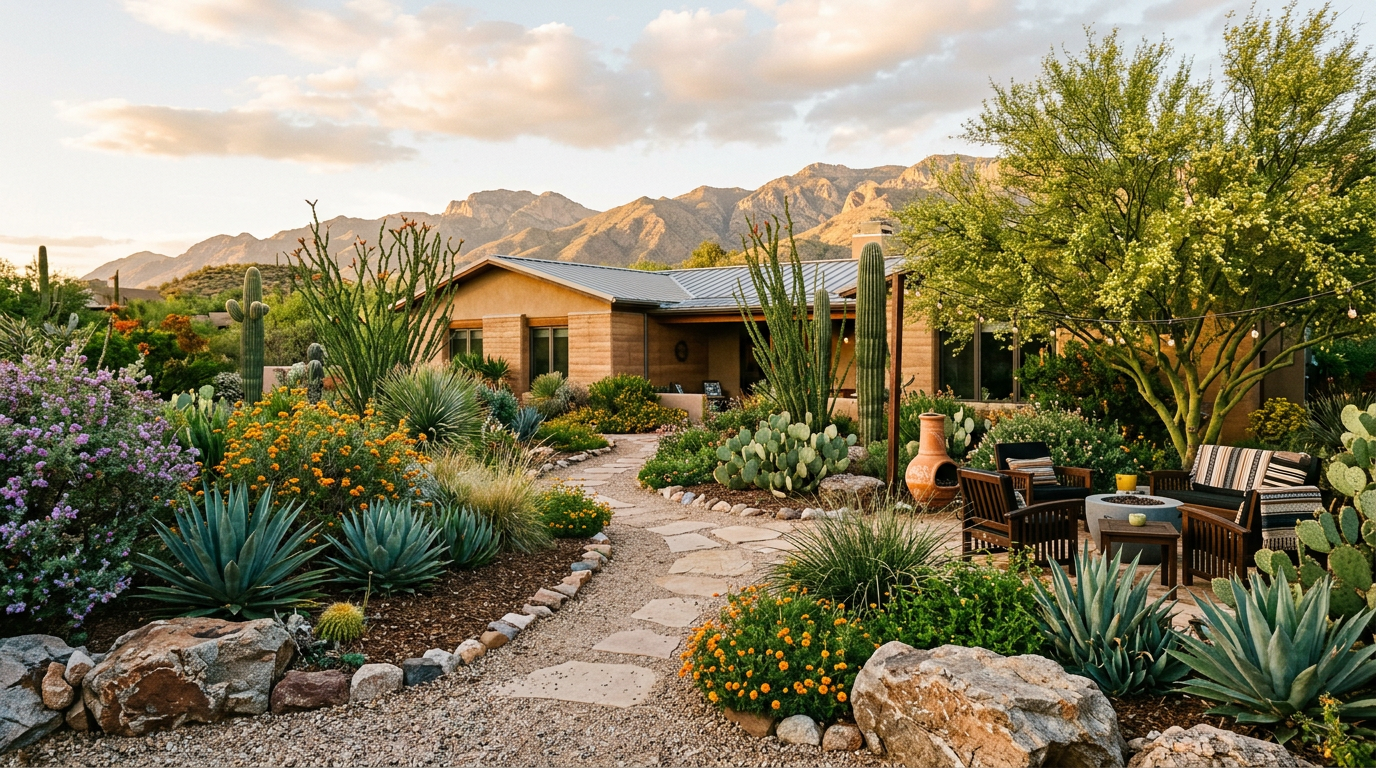
Let's be direct. Most front yards in Arizona look like sad, abandoned construction sites. A sea of uniform gray gravel, a token cactus, and maybe a sun-bleached plastic flamingo. It's a look that screams, "I give up." But it doesn't have to be this way. Your yard can be a vibrant, beautiful, and functional extension of your home—even in the face of 115°F summers and minimal rainfall. We're here to show you the Arizona desert landscaping ideas that go beyond the boring and create a space that actually works.
This isn't about fighting the desert; it's about embracing it. With the right plants, materials, and design, you can have a stunning, low-maintenance landscape that saves a shocking amount of water and looks incredible doing it.
Why Your Arizona Landscaping Needs a Different Playbook
You can't just import ideas from back East or even from our neighbors over in California. Landscaping in the Sonoran Desert is a different sport entirely. The rulebook is written by the sun and a severe lack of water. Your main opponents are:
- Intense Solar Radiation: The sun here doesn't just warm things up; it bakes them. Plants need to be tough enough to handle it, and unprotected patios can become unusable infernos.
- Extreme Heat: Forget gentle warmth. We're talking months of triple-digit temperatures that can scorch tender plants and make maintenance a miserable chore.
- Low Rainfall & Water Restrictions: Water is liquid gold. Cities like Scottsdale, Phoenix, and Tucson have tiered water rates and regulations designed to curb excessive use. A traditional lawn is not just impractical; it's financially irresponsible. This is a core concept we also see in Southern California drought landscaping.
According to the Arizona Department of Water Resources, outdoor water use can account for up to 70% of a home's total water consumption. Switching from a traditional lawn to a water-wise xeriscape can reduce that outdoor use by 50% or more, saving the average Phoenix household thousands of gallons—and hundreds of dollars—each year. (Source: https://new.azwater.gov/conservation/landscaping)
The Foundation: Hardscaping Your Arizona Yard Like a Pro
Before you plant a single thing, you need to lay the groundwork. In Arizona, hardscaping—the non-living elements of your design—is the star of the show. It provides structure, color, and weed control.
- Decomposed Granite (DG): This is your best friend. It’s a fine, sandy gravel that packs down to create a firm, natural-looking surface for paths and patios. It’s much more attractive than basic gravel. Colors range from gold and tan to gray. Expect to pay about $60-$80 per ton from a local supplier like Pioneer Sand or MDI Rock. A ton covers about 100 sq. ft. at a 2-inch depth.
- River Rock & Boulders: Use these to create visual interest and define spaces. A dry creek bed made of 3-6 inch river rock can look fantastic and help manage monsoon runoff. Large boulders (300+ lbs) act as powerful focal points. Pro tip: Always use an odd number of boulders (3 or 5) for a more natural look.
- Pavers and Flagstone: For high-traffic patios and walkways, you can't beat pavers or flagstone. Slate and quartzite are popular choices that hold up well in the sun. This is a bigger investment, often running $15-$25 per square foot installed, but it creates a permanent, high-value outdoor floor.
Mixing these materials is key. A yard of just one type of rock is monotonous. Use DG for the main field, pavers for the patio, and river rock for accents.
The Best Damn Plants for an Arizona Desert Landscape
Now for the fun part. Forget what you think you know about desert plants. We're not talking about a few lonely, spiky things. We're talking lush textures, brilliant colors, and life-giving shade.
Trees for Shade (and Sanity)
Shade isn't a luxury in Arizona; it's a necessity. A well-placed tree can lower the ambient temperature on your patio by 15-20 degrees.
- Palo Verde ('Desert Museum' variety): The quintessential desert tree. It has a green trunk, a beautiful open canopy that provides filtered shade, and brilliant yellow flowers in the spring. It's fast-growing and extremely drought-tolerant once established.
- Mesquite ('Thornless Chilean'): Another fast-grower that provides great filtered shade. It's tough as nails and requires very little water.
- Desert Willow: Not a true willow, this small tree produces gorgeous, trumpet-shaped flowers that attract hummingbirds all summer long. Perfect for smaller yards.
Architectural Statements & Focal Points
These are the plants that give your landscape that 'wow' factor.
- Agave: There are dozens of varieties. We love the Whale's Tongue Agave (Agave ovatifolia) for its wide, sculptural blue-gray leaves, or the Parry's Agave (Agave parryi) for its perfect, compact rosette. They need almost no water and look incredible.
- Red Yucca (Hesperaloe parviflora): Don't let the name fool you. It's not a yucca. This plant has grass-like leaves and sends up tall spikes of coral-red flowers from spring through fall. It's a hummingbird magnet and virtually indestructible.
- Golden Barrel Cactus: A classic for a reason. Plant them in groups of 3 or 5 for a stunning, modern look. They provide a perfect spherical contrast to spikier plants.
Can't-Kill Color
Your yard doesn't have to be just green and brown.
- Bougainvillea: Yes, it can be a bit messy, but nothing provides a sheer explosion of color like a bougainvillea. Pinks, purples, oranges, reds—it's a showstopper. Plant it against a wall that gets full, relentless sun.
- Lantana: This sprawling shrub is covered in flowers nearly year-round. The newer varieties are sterile, so they don't re-seed aggressively. It's tough, drought-tolerant, and beloved by butterflies.
- Penstemon ('Firecracker' or 'Parry's'): These perennials send up spikes of tubular flowers that are irresistible to hummingbirds. They provide great vertical accents and a pop of red or pink.
Water-Wise Irrigation: The Only System That Matters in Arizona
Throw out your sprinklers. Seriously. In the Arizona heat, up to half the water from a sprinkler can evaporate before it even hits the ground. It's wasteful and ineffective. This is a stark contrast to places that need broad coverage for turf, like you might find in a Texas lawn care guide.
The only irrigation system you should be using is drip irrigation.
We learned the hard way that a 'set it and forget it' sprinkler system in Scottsdale will just get you a huge water bill and a bunch of fried plants. Drip systems deliver water slowly and directly to the plant's root zone. This encourages deep root growth and minimizes water loss to evaporation.
A good setup consists of a timer (we like the B-hyve Smart Wi-Fi Hose Faucet Timer, about $70), a pressure regulator, and a network of 1/2" poly tubing with 1/4" lines running to individual emitters at each plant. You can get a complete DIY kit from Rain Bird or DIG for $100-$300 to cover a typical yard. Set it to run early in the morning (like 4 AM) for 1-2 hours, once or twice a week in the summer, and much less in the winter.
Beating the Heat in Arizona: Shade Structures and Outdoor Living
Your beautiful new landscape is pointless if it's too hot to enjoy. Creating shade is just as important as choosing plants. While some principles of creating usable outdoor space are universal, our needs are more extreme than in places like Colorado. Landscaping ideas for Colorado that actually work might focus on windbreaks, while here, it's all about sun protection.
- Shade Sails: These are a relatively inexpensive and stylish way to shade a patio or seating area. A good quality 12'x12' sail from a brand like Coolaroo will run you about $100-$150. The key is using sturdy, well-anchored posts (4x4s or metal poles set in concrete).
- Pergolas and Ramadas: A more permanent and substantial option. A wooden pergola can support climbing vines like Bougainvillea or Pink Trumpet Vine, creating a living shade canopy. A ramada with a solid roof provides all-day, all-weather protection and makes a space feel like a true outdoor room.
- Fire Pits: It might sound crazy, but our cool, clear desert nights are perfect for a fire pit. It becomes a natural gathering spot from October through April. A simple steel fire pit bowl costs under $100, while a built-in gas fire pit can be a major upgrade.
By combining these elements—smart hardscaping, tough-as-nails plants, efficient watering, and strategic shade—you can create an Arizona landscape that's not just survivable, but truly spectacular.
Frequently asked
What is the cheapest way to landscape a desert yard in Arizona?+
The cheapest method is using local decomposed granite for groundcover, planting a few key native plants from a nursery like Moon Valley, and mulching heavily. Avoid expensive flagstone patios and large, mature trees initially. Focus on smaller, younger plants that will grow in over time.
Is fake grass a good idea in Arizona?+
It can be, but choose high-quality, heat-resistant turf. Cheap artificial grass can get extremely hot (over 150°F), melt, and look fake. It saves water but offers zero habitat for pollinators and requires periodic cleaning. It's a significant trade-off.
What should I not plant in my Arizona yard?+
Avoid high-water plants like traditional turfgrass (Fescue, Kentucky Bluegrass), big-leaf hydrangeas, many non-native ferns, and fruit trees that aren't specifically adapted for low-desert climates. These will struggle in the heat and consume enormous amounts of water to survive.
How much does desert landscaping cost in Arizona?+
A DIY installation can cost as little as $2-$5 per square foot, focusing on groundcover and smaller plants. Professional installation typically runs $8-$20+ per square foot, depending on the complexity, plant maturity, and hardscaping materials like pavers or retaining walls.
How do I keep weeds out of my desert landscaping?+
First, install a high-quality landscape fabric under your rock or granite. Second, apply a pre-emergent herbicide (like Preen) twice a year, in the fall and late winter, before weeds sprout. This prevents 90% of the problem. Hand-pull any that break through.