
Why Is My Lawn Yellow? 7 Causes and Fixes That Work
A yellow lawn is a cry for help. We'll show you how to figure out if it's thirst, hunger, pests, or something else—and exactly how to fix it.
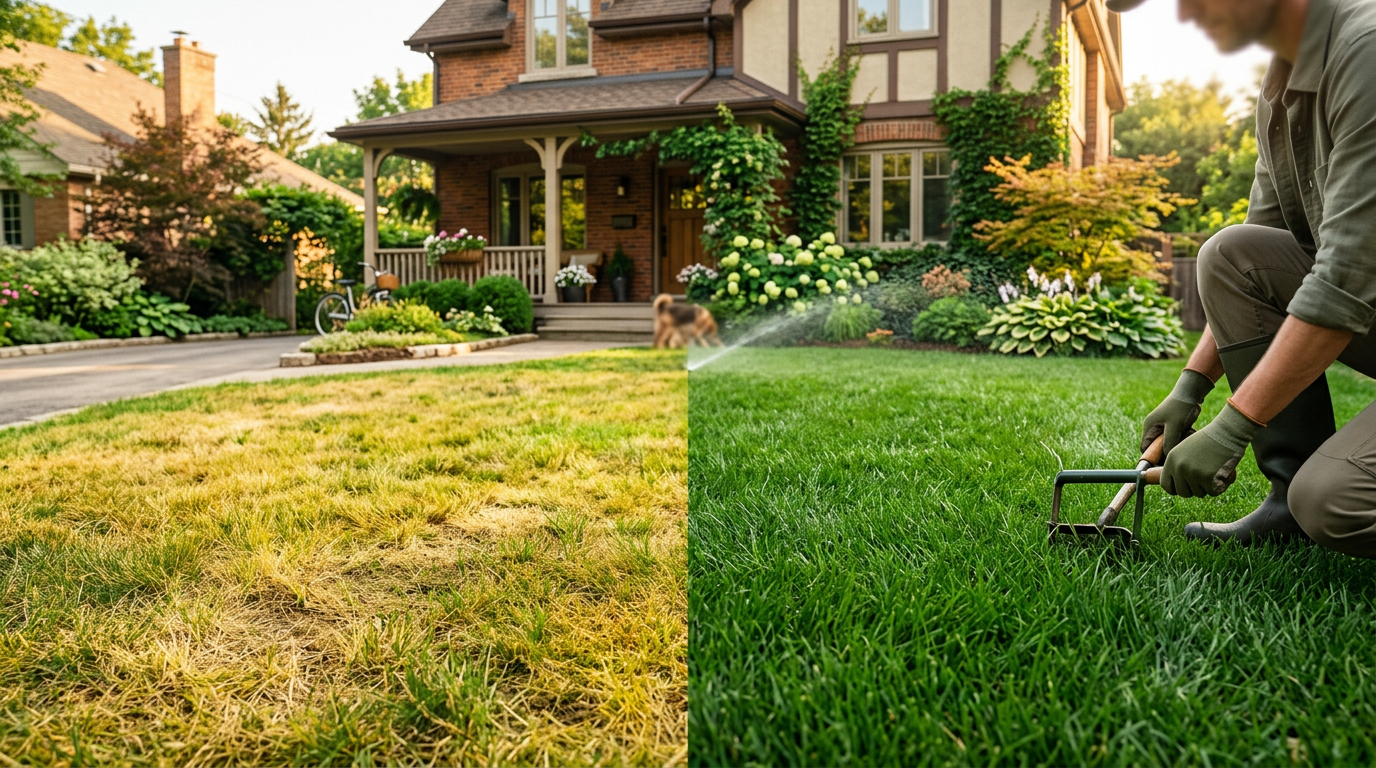
A yellow lawn is one of the most frustrating sights for a homeowner. You do all this work—mowing, watering, pulling weeds—and instead of a lush green carpet, you get something that looks sad, tired, and jaundiced. What gives?
Don't reach for the miracle-cure-in-a-bag just yet. A yellow lawn is a symptom, not a disease. It's your grass telling you something is wrong. Our job is to play detective, figure out what it's saying, and apply the right fix without wasting time or money. We've seen every shade of yellow, and we're here to walk you through the most common causes and the no-nonsense solutions that actually work.
1. It’s Thirsty: Drought Stress
This is the most common culprit, especially in summer. When grass doesn't get enough water, it stops growing and goes dormant to conserve resources. The first sign is a bluish-gray tint, which quickly fades to yellow or straw-brown.
The Test: The Footprint Test. Walk across your lawn. If the grass blades spring right back up, they're hydrated. If your footprints remain flattened for more than a few minutes, the grass is dehydrated and under drought stress.
The Fix: Water deeply and infrequently. Forget a light sprinkle every day. That encourages shallow roots. You need to deliver 1 to 1.5 inches of water per week, all at once or split into two sessions. To measure this, place a few empty tuna cans around your lawn before you turn on the sprinkler. Time how long it takes to fill them to the 1-inch mark. Now you know your target watering time.
For a set-it-and-forget-it solution that adapts to local weather, a smart sprinkler controller like the Rachio 3 (around $199) is a game-changer. It saves water and prevents you from accidentally overwatering, which causes its own problems.
2. It’s Hungry: Nutrient Deficiency
Grass is a heavy feeder. If your lawn is a uniform, pale yellow, it's likely starving. The nutrient it craves most for that deep green color is Nitrogen (N).
- Nitrogen Deficiency: Causes chlorosis, a condition where the plant can't produce enough chlorophyll. The result is a weak, spindly, yellow lawn. If you're seeing a lot of clover pop up, that's another big clue, as clover thrives in low-nitrogen soil. Don't just hate the clover, listen to what it's telling you about your soil before you look into how to get rid of clover in your lawn.
- Iron (Fe) Deficiency: Can also cause yellowing, but it typically appears on the new grass blades first, while the older blades remain greener.
The Fix: Before you dump a bag of random fertilizer on it, test your soil. We can't say this enough. Guessing is for amateurs. A DIY kit like the MySoil Soil Test Kit ($29.99) gives you a professional lab analysis of your soil's pH and nutrient levels. Once you have the results, you can apply what's actually needed.
If the test confirms low nitrogen, apply a quality granular fertilizer like Scotts Green Max Lawn Food, which is high in nitrogen and contains 5% iron for extra greening. For a more organic approach, Milorganite is a fantastic slow-release fertilizer that provides both nitrogen and non-staining iron.
3. Something’s Eating It: Grubs & Pests
If you have irregular, splotchy yellow patches that feel spongy underfoot and pull up easily, you might have grubs. These C-shaped beetle larvae live in the soil and feast on grass roots.
The Test: The Tug Test. Grab a handful of the yellow grass and give it a gentle but firm pull. If the turf lifts up like a piece of old carpet with no roots attached, you've found your problem. You'll likely see the fat, white grubs right underneath.
The Fix: First, you need to be sure what you're dealing with. Our guide to white grubs in soil identification will help you tell them apart from other harmless larvae. Once confirmed, you have a few options:
- Chemical: Apply a curative insecticide like Scotts GrubEx1 in late spring or early summer. It costs about $35 for a 10,000 sq. ft. bag and kills the grubs before they can cause major damage.
- Natural: For an organic approach that's safe for pollinators and pets, check out our guide on how to get rid of grubs in your lawn naturally. Options like beneficial nematodes and milky spore disease are highly effective when applied correctly.
4. It's Sick: Lawn Fungus
Fungus can be tricky because it often looks like drought stress at first. But fungal diseases create more distinct patterns—like yellow rings (Necrotic Ring Spot), small silver-dollar-sized circles (Dollar Spot), or threaded patches (Red Thread).
The Fix: Most lawn fungi thrive in damp, warm conditions. The first line of defense is cultural:
- Water early in the morning, so the grass blades can dry during the day.
- Improve air circulation by mowing regularly and trimming overhanging tree branches.
- Aerate your lawn annually to reduce compaction.
If the fungus is aggressive, a fungicide may be necessary. A broad-spectrum hose-end product like BioAdvanced Fungus Control for Lawns (around $22) can be effective. For a precise diagnosis, see our visual lawn fungus identification guide to match your symptoms to the right disease and treatment.
5. It’s Being Bullied: Soil Compaction & Thatch
If your lawn gets a lot of foot traffic, the soil underneath can become hard as a rock. This compaction squeezes out air and makes it nearly impossible for water and nutrients to penetrate to the roots. A thick layer of thatch—the dead-but-not-decomposed layer of stems and roots between the soil and the green grass—does the same thing.
According to research from the University of Minnesota Extension, a thatch layer thicker than 1/2 to 3/4 of an inch creates a barrier that severely restricts the movement of water, air, and fertilizer to the soil. This leads to a shallow root system that is much more vulnerable to heat and drought, causing—you guessed it—yellowing. (Source: https://extension.umn.edu/lawn-care/thatch-management-home-lawns)
The Test: The Screwdriver Test. Try to push a standard screwdriver into your lawn's soil. If it goes in easily, you're fine. If you have to put your full body weight on it to get it a few inches deep, your soil is compacted.
The Fix: For compaction, the gold standard is core aeration. Rent a machine for about $100 for a half-day or hire a local crew. It pulls up plugs of soil, relieving pressure and opening up channels for air and water. For thatch, use a dethatching rake or rent a power rake to comb out the dead layer.
6. It’s Owner Error: Mowing, Spills, & Pets
Sometimes, we are our own worst enemy.
- Mowing Too Short (Scalping): Cutting your grass too low stresses the plant and removes too much of the photosynthetic blade, causing it to turn yellow-brown. Follow the one-third rule: never cut more than one-third of the grass blade's height in a single mowing.
- Fertilizer or Gas Spills: Spilling concentrated fertilizer or gasoline while refueling your mower will kill the grass, creating a distinct dead, yellow patch. Flush the area with tons of water immediately and reseed.
- Dog Urine: Dog urine is high in nitrogen salts, which act like a fertilizer burn. This creates the classic "Fido Spot": a dead yellow circle often surrounded by a ring of dark green grass. Train your dog to use one area of the yard, or follow them with a hose to dilute the spot immediately after they go.
Your Action Plan for a Greener Lawn
Don't get overwhelmed. Start with the simplest diagnosis and work your way down.
- Check Water: Do the footprint test. Is the soil dry? Adjust your watering schedule.
- Check Mowing Height: Are you cutting it too short?
- Check for Pests: Do the tug test in a yellow patch.
- Get a Soil Test: Stop guessing and find out what your soil actually needs.
- Address Compaction: If all else fails, it's time to aerate.
By systematically identifying the real problem, you can stop throwing money at useless products and start giving your lawn what it actually needs to be healthy and green.
Frequently asked
Can a yellow lawn turn green again?+
Yes, absolutely. Once you identify and fix the underlying issue—be it lack of water, nutrients, or a pest problem—the grass can recover. For dead patches, you may need to overseed, but the surrounding yellow grass will usually bounce back to green with proper care.
What is the fastest way to fix a yellow lawn?+
If the cause is a simple nitrogen deficiency, the fastest fix is a liquid lawn fertilizer. It's absorbed quickly through the blades and roots. Products like Simple Lawn Solutions 16-4-8 can show visible greening in a few days, but be sure it's what your lawn actually needs first.
How do you fix yellow grass from dog pee?+
The best fix is dilution. Water the spot thoroughly right after your dog urinates to flush away the concentrated nitrogen salts. For existing spots, rake out any dead grass, flush the area generously with water to leach the salts, and then reseed the bare patch.
What nutrient makes grass dark green?+
Nitrogen is the primary nutrient responsible for the lush, dark green color in grass. It's a core component of chlorophyll, which is essential for photosynthesis. Iron is a secondary micronutrient that also aids in chlorophyll production and contributes to a deep green hue without forcing excessive growth.