
Mushrooms Growing in Lawn: Causes, Safety, Fast Fixes That Work
Mushrooms in your lawn aren’t a crisis. They’re a moisture + organic matter signal. We’ll show you what to do today and how to stop repeat outbreaks.
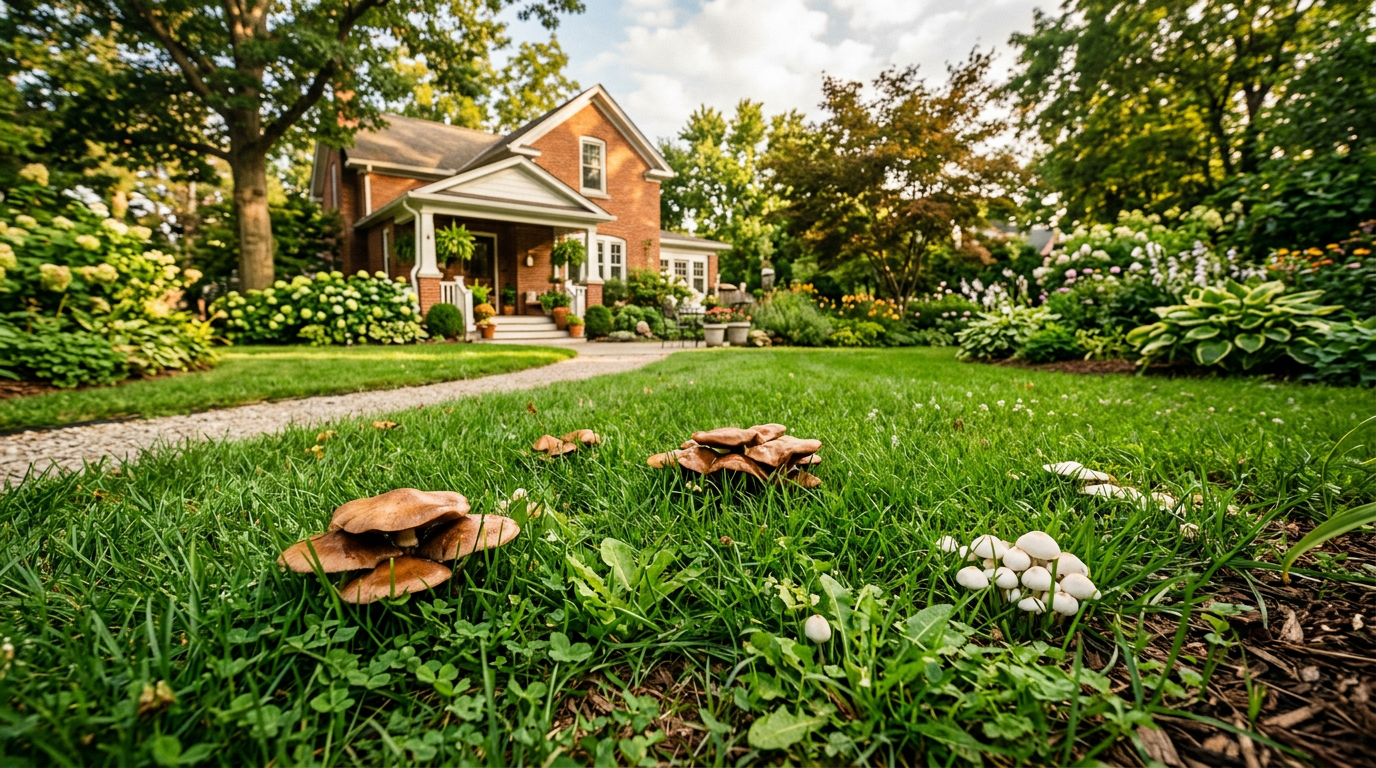
Why mushrooms pop up after rain (and why it’s not a crisis)
Mushrooms in turf are the fruiting bodies of saprophytic fungi. Translation: they’re recycling buried wood, thatch, old roots, or pet waste. Add shade and steady moisture, and up they come—especially after a soaking. They’re usually harmless to grass. The fix isn’t magic spray; it’s reducing food and moisture.
We’ve dealt with every version: new sod laid over construction debris, shady corners with thick thatch, even fairy-ring arcs. Same playbook works 90% of the time.
Are lawn mushrooms dangerous?
To your lawn: no. To kids, pets, and curious snackers: potentially. Many lawn mushrooms are inedible; some are toxic. We pick and trash them during flushes. Don’t compost caps, and don’t pulverize them with a mower—no need to broadcast spores.
If you’re also seeing brown patches or off-color turf, check our quick guides: Lawn Fungus Identification: Fast Visual Guide + Fixes and Brown Patches in Lawn After Winter: Causes + Fixes.
Do this today (fast, safe cleanup)
- Glove up, twist-pull caps at the base, and toss in the trash.
- Dial back irrigation: most lawns need about 1 inch of water per week, total rain + irrigation.
- Water at dawn only. Evening watering keeps surfaces wet and mushrooms happy.
- Raise your mower to 3–4 inches; taller grass dries soil more evenly.
- Rake up visible wood chips, remove buried scraps if you hit them, and spot-topdress low spots with sand/compost to improve drainage.
Named tools we actually use:
- Yard Butler Lawn Coring Aerator (~$39). Simple plug aerator for small areas.
- Ames Thatch Rake (~$45). Manual, but it chews through thatch.
- Sun Joe AJ801E Dethatcher/Scarifier (~$159). For bigger thatch problems on a budget.
Longer-term fixes that stop repeat flushes
- Keep thatch under 0.5 inch. Dethatch or scarify in active growth season.
- Core-aerate compacted areas; follow with a thin compost topdress to feed microbes that outcompete mushrooms.
- Improve drainage: fix low spots, break up clay with repeated aeration, and avoid nightly watering.
- Reduce shade where reasonable—more sun = drier canopy.
- Remove the food source: old stumps, roots, buried lumber, thick mulch layers.
Pro tip we use for stubborn fairy-ring thatch: after dethatching, a light, quick-release nitrogen bump helps soil microbes finish the job. Example: Espoma Urea 46‑0‑0 (~$15/4 lb). Apply no more than 0.5 lb N per 1,000 sq ft, water in, and only during active turf growth.
Numbers that matter (and why)
Extensions advise thatch under 0.5 inch and watering about 1 inch/week. Overwatering and thick thatch hold moisture, which encourages fruiting. Mushrooms often disappear in a few days once surfaces dry. See NCSU on thatch thresholds and management (https://content.ces.ncsu.edu/thatch-management) and UMN on mushrooms in lawns (https://extension.umn.edu/plant-diseases/mushrooms-lawns).
Fairy rings: the one mushroom problem that needs a plan
Fairy rings can form dark-green arcs, dead strips, or just ringed mushrooms. The soil can even become water-repellent. Our playbook:
- Core-aerate heavily along the ring.
- Soak deeply with a wetting agent. Hydretain Root Zone Moisture Manager (~$35/quart) helps water penetrate hydrophobic zones.
- Light nitrogen to even color after mechanical work.
- Repeat wetting + aeration cycles until symptoms break.
Severe Type I rings (dead/dry bands) may need aggressive dethatching and even trenching the ring edge. If you must bring chemistry, see below.
Should you spray a fungicide?
Usually no. Fungicides don’t remove the buried food; they just suppress fruiting temporarily. For severe fairy rings where wetting + aeration aren’t enough, a strobilurin like azoxystrobin can help when combined with wetting agents and heavy watering-in. Example: Scotts DiseaseEx (azoxystrobin), ~$24/10 lb. Read the label; time applications during active turf growth.
If you’ve got holes, grubs, or other critter damage alongside mushrooms, you might be stacking problems. Cross-check: White Grubs in Soil Identification: Pictures, Look‑Alikes, How to Get Rid of Grubs in Lawn Naturally (That Works), and Tiny Holes in Lawn at Night: What’s Making Them + Fixes.
What not to do (we tested these so you don’t have to)
- Dish soap, bleach, salt, or vinegar: they burn turf and don’t fix the cause.
- Lime: mushrooms aren’t an acidity problem.
- Constant mowing over fruiting bodies: just spreads mess. Pick, toss, move on.
Bottom line: dry the surface, remove the food, improve airflow. The mushrooms get bored and leave.
Frequently asked
Are lawn mushrooms harmful to grass?+
No. Most lawn mushrooms are saprophytic, feeding on dead wood or thatch without attacking living grass. They’re a sign of moisture plus organic material. Focus on dethatching, aeration, and drainage rather than fungicides, unless you’re dealing with severe fairy rings.
Should I remove mushrooms or let them be?+
Pick and trash them if you have kids or pets, or if you don’t want spores spreading. Removing caps won’t stop the fungus, but it reduces nuisance and risk. Long-term control comes from drying the surface and removing the underlying food source.
Will dish soap or baking soda kill mushrooms?+
They may scorch mushrooms—and your lawn. Soap, salt, vinegar, and baking soda harm turf, don’t remove buried wood/thatch, and often make spots worse. Skip home-brew sprays. Fix moisture and thatch; mushrooms fade when conditions change.
How do I stop fairy ring in my lawn?+
Mechanically break it up: core-aerate along the ring, apply a wetting agent, soak deeply, and repeat cycles. Light nitrogen evens color. For stubborn Type I rings, combine with dethatching and, if needed, azoxystrobin plus wetting agent, watered in per label.
Are lawn mushrooms poisonous to dogs?+
Some can be. Assume they are and remove them. Monitor pets during mushroom flushes, pick and trash caps, and call your vet if ingestion is suspected. Prevent returns by reducing moisture, removing thatch, and clearing buried organic debris.