
Mushrooms Growing in Lawn: Causes, Fixes, Prevention
Mushrooms in your lawn = a fungus telling you the soil’s holding moisture and digesting buried organic bits. Here’s why they pop up and how we stop the flushes for good.
Quick take
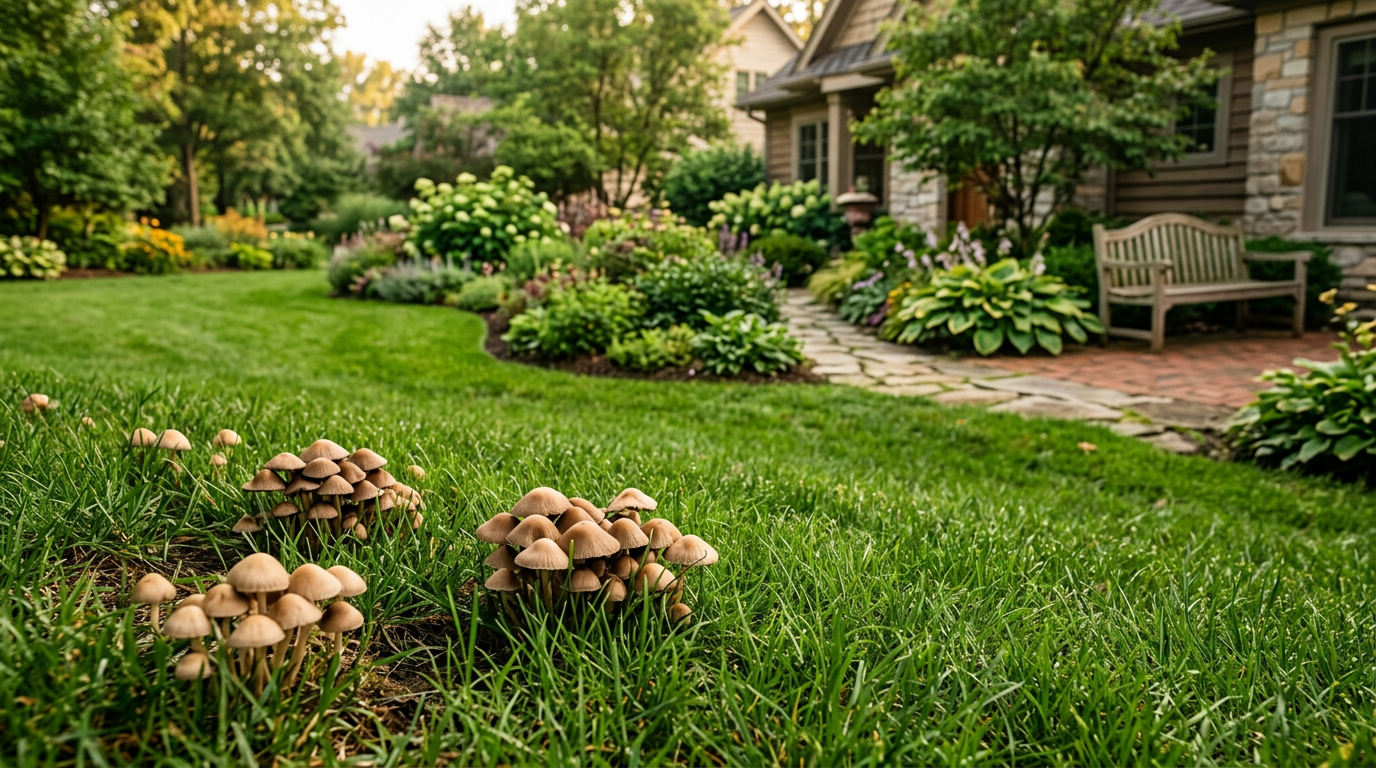
Mushrooms popping after rain aren’t your lawn “rotting.” They’re fruiting bodies from fungi digesting buried wood, thick thatch, or old roots. We’ve cleaned this up in test yards by removing the food source, drying the surface, and opening the soil. Here’s the plan without the gatekeeping.
Why mushrooms show up in lawns
You need three things for a mushroom flush:
- Food: buried wood chips, old stumps/roots, thatchy layers, or heavy leaf litter.
- Moisture: over‑irrigation, poor drainage, compacted soil, dense shade, cool rainy spells.
- Calm, cool-ish weather: 55–75°F soil temps and humid air are perfect.
Most lawn mushrooms are saprophytic (they eat dead stuff), not pathogens. If you’re worried about turf diseases (brown patch, dollar spot), see our visual guide: Lawn Fungus Identification: Pictures, Symptoms, Fixes.
Are lawn mushrooms bad?
For grass health, not really. They’re decomposers helping recycle organic matter. For people and pets, treat unknown mushrooms as toxic—don’t nibble, and pick them before kids or dogs do. If your turf is thinning in rings or showing hydrophobic (water‑repelling) spots, you may be dealing with a fairy ring—still fixable.
Fast clean-up (today)
- Pick, don’t mulch: Hand‑pick or rake mushrooms and trash them. Bag mower clippings if you mow over them so you’re not spreading spores.
- Water smarter: Skip irrigation until the top 2–3 inches dry. Then water deeply and infrequently (once or twice a week, 0.5–1 inch per session) instead of daily sips.
- Improve air/sun: Prune lower tree limbs or thin shrubs to let sun and breeze hit the lawn.
- Pet waste: Remove promptly; it’s a moisture/food point for assorted fungi.
Long-term fixes (what actually stops the flushes)
- Remove the food source. If mushrooms cluster over an old stump hole, dig out remaining chips/roots. A mattock like Fiskars IsoCore 5‑lb Pick/Mattock (~$69) makes fast work. If it’s a small patch, even a serrated sod knife (~$15) helps peel back turf to scoop chips.
- Dethatch if the layer is >0.5 inch. A manual thatch rake works, but for speed: Greenworks 10A 14‑in Dethatcher/Scarifier (~$129). Compost or haul the debris.
- Core aerate compacted soil. Pull real cores—don’t just spike. Yard Butler ID‑6C Coring Aerator (~$39) for small yards, or rent a plug aerator (~$75/day) for bigger spaces.
- Topdress and overseed. Brush in 1/4 inch compost or sandy loam after aeration to improve drainage and biology, then overseed bare spots.
- Water deep, not often. Program irrigation to deliver 0.75–1 inch per cycle and allow drying between.
If your wet spots become brown circles later, that’s not the mushrooms—it’s moisture stress or disease. Troubleshoot here: Brown Patches in Lawn After Winter: Causes + Fixes.
Fairy rings: special case
Fairy rings often present as: dark green rings (extra nitrogen release), mushrooms in a ring, or a dead grass ring where soil turns water‑repellent.
- Aerate the ring aggressively (multiple passes).
- Apply a soil wetting agent to re‑wet hydrophobic zones. Hydretain Root Zone Moisture Manager (~$35/qt) or Revive Soil Treatment (~$22/gal) are lawn‑safe options—water them in.
- Heavily water through the aeration holes to break the dry layer. Repeat weekly until infiltration improves.
Fungicides rarely touch established saprophytic rings because the mycelium runs deep and wide. Cultural fixes work.
Numbers that matter
- Thatch thicker than 0.5 inch is considered excessive; dethatch to reduce moisture‑holding thatch and fungus food (extension.missouri.edu/publications/g6700).
- For compaction, aim for roughly 20–40 core holes per square foot when aerating to meaningfully change infiltration (extension.umn.edu/lawn-care/aeration).
- Mushrooms are mostly water—about 92% by weight—which is why they explode after rain and vanish when it dries (fdc.nal.usda.gov).
What not to do
- Don’t spray bleach, vinegar, or salt. You’ll burn turf and wreck soil.
- Don’t expect fungicides to “cure” lawn mushrooms; they target pathogens, not saprophytes.
- Don’t scalp the lawn. Short grass holds less leaf area and more heat stress—counterproductive.
Our field note
We inherited a lawn that sprouted dozens of caps after every summer storm. We peeled back a 3x3 patch, removed a buried layer of stump chips, core‑aerated twice, topdressed with compost, and switched to once‑a‑week deep watering. Mushroom count dropped from ~60 per storm to 3–5 strays in two weeks.
If you’re seeing critter damage overnight (holes, torn turf) while mushrooms are out, it’s likely animals hunting grubs, not the mushrooms. Start here: White Grubs in Soil Identification: Pictures, Look‑Alikes and Tiny Holes in Lawn at Night: What’s Making Them + Fixes.
Frequently asked
Will lawn mushrooms kill my grass?+
Usually no. Most lawn mushrooms are saprophytes feeding on dead wood or thatch, not live turf. If you see rings of dark green or dead grass (fairy ring), address soil hydrophobicity with aeration and wetting agents, plus remove buried organic matter to restore normal growth.
How do I get rid of mushrooms in my lawn permanently?+
Remove their food (buried wood, thick thatch), reduce surface moisture, and open the soil. Dethatch if >0.5 inch, core aerate to improve infiltration, prune for more sun, and adjust watering to deep, infrequent cycles. Picking caps helps aesthetics, but long-term control is about soil and debris.
Do fungicides work on mushrooms in grass?+
Rarely. Lawn mushrooms are fruiting bodies of saprophytic fungi that live deep in soil/thatch. Fungicides are designed for pathogenic diseases and won’t eliminate the underlying food or moisture conditions. Cultural fixes—debris removal, aeration, dethatching, and watering changes—are far more effective.
Are lawn mushrooms poisonous to dogs or kids?+
Some species are toxic, and it’s hard to ID safely in a yard. Assume unknown mushrooms are poisonous. Pick and trash caps promptly and supervise pets/children. If ingestion happens, contact a poison control center or veterinarian and keep a sample for ID. Prevention: reduce mushrooms by drying and cleanup.
Why do mushrooms appear after I mow?+
Mowing can spread spores and keep moisture at the canopy. If the lawn was already primed—wet soil, buried organic matter—mushrooms may pop within 24–48 hours. Bag clippings when mushrooms are present, water less frequently, and address thatch/compaction to remove the conditions they love.