
How to Dethatch a Lawn: A Step-by-Step Guide
Got a thick, spongy layer strangling your turf? We'll show you exactly how to dethatch a lawn, from choosing the right tools to the crucial post-dethatching care.
Your lawn feels… spongy. It’s like walking on a thick, wet carpet instead of firm turf. You water, you fertilize, but it still looks stressed and patchy. What gives?
Chances are, your lawn is being choked by thatch. This dense layer of dead (and living) organic matter is suffocating your soil and starving your grassroots. The solution isn't more fertilizer; it's a bit of tough love called dethatching.
Don't let the name intimidate you. Dethatching is just a fancy term for raking up all that junk. We're going to walk you through exactly how to do it, when to do it, and what tools you need. Let’s get that lawn breathing again.
What is Thatch, Anyway?
Thatch is the layer of tangled stems, runners, and roots that builds up between the green blades of grass and the soil surface. It’s a mix of living and dead organic material. A thin layer (less than ½ an inch) is actually beneficial. It acts like a natural mulch, conserving moisture and protecting the root crowns.
But when it gets too thick—anything over ½ an inch—it becomes a problem. This dense mat acts like a waterproof barrier, preventing water, air, and fertilizer from reaching the soil and the roots of your grass. It can also harbor pests and diseases, creating a perfect environment for fungus to thrive while your turf struggles.
How do you know if you have a thatch problem? Grab a trowel or a knife and cut out a small wedge of your turf, about 3 inches deep. Look at the cross-section. You'll see the green grass on top, the soil on the bottom, and a brown, spongy layer in between. If that layer is thicker than your thumb (about ½ to ¾ of an inch), it’s time to take action.
When is the Best Time to Dethatch?
Timing is everything. Dethatching is a high-stress event for your lawn, so you need to do it when the grass is actively growing and can recover quickly. This depends entirely on what kind of grass you have.
For Cool-Season Grasses (Kentucky Bluegrass, Fescue, Perennial Ryegrass): The best time to dethatch is in late summer or early fall. The second-best time is early spring after the grass has started growing vigorously. The soil is warm, the temperatures are mild, and the grass has plenty of time to heal before the stress of winter or summer heat sets in.
For Warm-Season Grasses (Bermuda, Zoysia, St. Augustine, Centipede): You'll want to dethatch in late spring or early summer, once the grass has fully greened up and is growing strong. This gives it the entire summer to recover. If you're trying to manage one of these aggressive growers, like some of the best grass types for your Alabama lawn, you might find you need to dethatch more regularly to keep them from getting choked out.
Never dethatch a dormant or stressed lawn (like during a drought or mid-summer heatwave). You’ll do more harm than good.
The Tools of the Trade: Manual vs. Power Dethatchers
You have two main choices here, and the right one depends on the size of your lawn and your tolerance for manual labor.
Manual Dethatching Rakes
For small lawns (under 1,000 sq. ft.) or lawns with a minor thatch problem, a manual thatching rake is a great, affordable option. These aren't your garden-variety leaf rakes. They have sharp, curved steel tines designed to dig into the thatch layer and pull it up. A solid choice is the AMES 2915100 Steel Tine Thatch Rake, which you can find for around $40.
The upside: It's cheap, gives you great control, and provides a heck of a workout. The downside: It is a workout. Dethatching a medium-sized lawn by hand is a serious physical commitment.
Power Dethatchers (aka Power Rakes or Scarifiers)
For lawns larger than a postage stamp, a power dethatcher is your best friend. These machines use rotating tines (flail blades) or fixed knife-like blades (a scarifier) to slice through the thatch and pull it to the surface. We've used both, and for anything over 1,000 sq ft, our backs scream for the power rake.
- Rental: Your local home improvement store or tool rental shop (like Sunbelt or United Rentals) will have commercial-grade power rakes for rent. Expect to pay around $70 - $100 for a half-day rental.
- Purchase: If you have aggressive grass or know you'll need to do this bi-annually, buying an electric model can be cost-effective. The Greenworks 14-Inch 10A Corded Dethatcher 27022 is a popular homeowner model that costs about $150. It's less powerful than a gas rental unit but gets the job done on most suburban lawns.
A note on terminology: People use 'power rake,' 'dethatcher,' and 'scarifier' interchangeably. Technically, a power rake with flail tines is for thatch removal, while a scarifier with fixed blades is more aggressive and cuts into the soil (a process called verticutting). For most homeowners, a power rake/dethatcher is what you need.
Step-by-Step Guide: How to Dethatch Your Lawn
Ready? Here’s the game plan.
-
Mow the Lawn: A day or two before you plan to dethatch, mow your lawn about one-third shorter than your usual height. Check our guide on how often to mow your lawn for tips on proper height. This makes it easier for the tines to reach the thatch layer. Bag the clippings.
-
Mark Obstacles: Walk your lawn and mark any sprinkler heads, valve box covers, or shallow irrigation lines with flags. You do not want to hit these with a power dethatcher.
-
Set the Depth: If using a power rake, set the blade depth. You want the tines to just be scratching the top of the soil. Start on a high setting for a test pass. The goal is to pull up thatch, not to till your entire lawn into a dirt patch. For a manual rake, it’s all about the angle and pressure you apply.
-
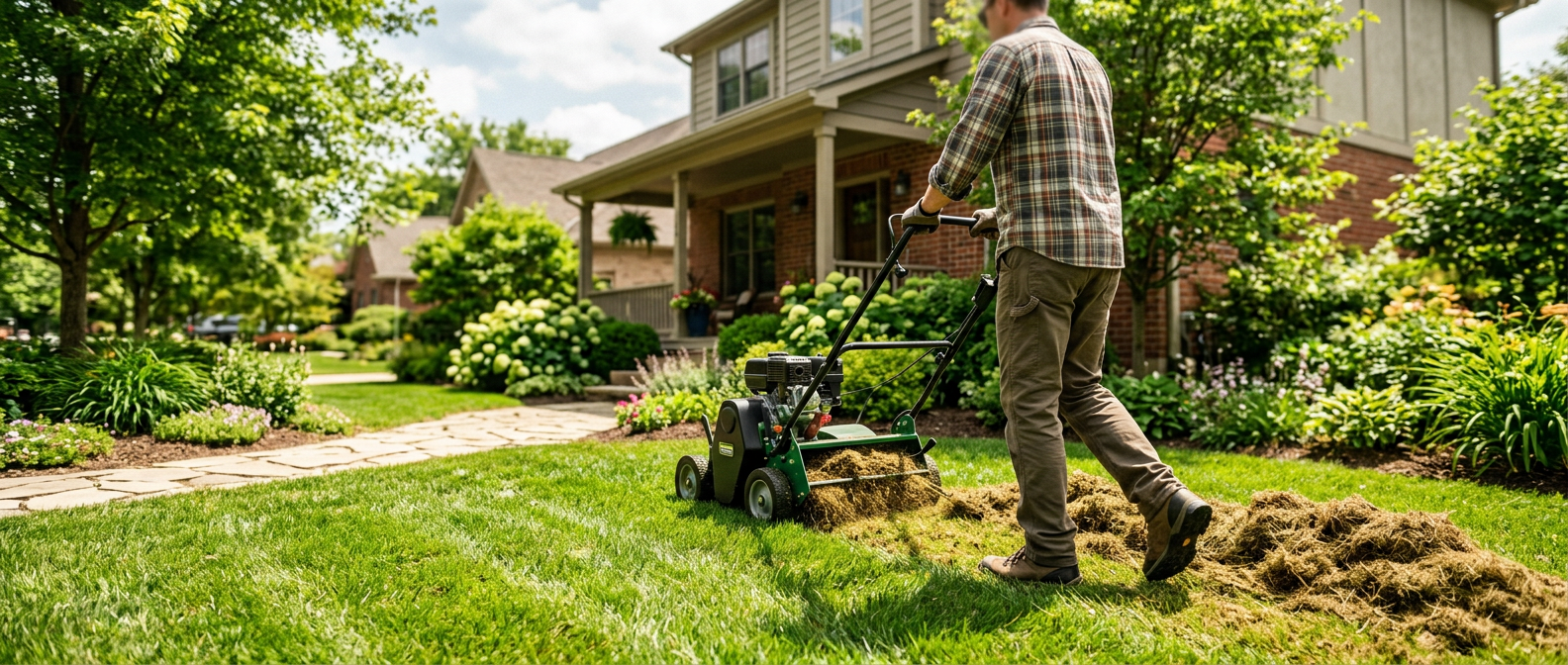
Make Your First Pass: Run the dethatcher over your entire lawn in straight, parallel lines, just like you’re mowing. You will be absolutely shocked by the amount of dead material this pulls up. It will look like you’ve skinned your lawn. This is normal.
-
Make Your Second Pass: For a thorough job, make a second pass over the entire lawn at a 90-degree angle to your first pass (a crisscross pattern). This ensures you get thatch that was missed on the first go-around.
-
Rake and Remove: Now for the cleanup. Use a standard leaf rake to gather the mountains of thatch debris. Seriously, you might have a dozen or more bags of a stuff from an average-sized yard. Get it all off the lawn so the turf can breathe.
The Aftermath: What to Do After Dethatching
Your lawn will look terrible. It will be patchy, brown, and generally sad-looking. Do not panic. You just performed major surgery, and now it’s time for recovery. This is the most important part of the process.
Immediately after clearing the debris, your soil is exposed and ready to accept everything it needs. This is the single best opportunity you will have all year for lawn improvement.
- Overseed: If your lawn is thin or patchy, now is the time to spread grass seed. The seed-to-soil contact will be perfect, and germination rates will be through the roof. This is a critical step we detail in our guide on how to overseed a lawn.
- Fertilize: Apply a starter fertilizer to help the existing grass recover and to give the new seed the nutrients it needs to get going.
- Water: Lightly water the lawn every day for the first week or two to keep the soil and new seed moist. Once the new grass is established, you can return to a normal schedule. Knowing the best time to water grass is key to promoting deep root growth and preventing disease.
Within 2-3 weeks, you’ll see your lawn transform. The old grass will recover, the new grass will sprout, and you’ll be on your way to the thickest, healthiest turf on the block.
Preventing Thatch Buildup in the First Place
Wouldn't it be nice to do this less often? You can. Thatch buildup is often a symptom of other cultural practices.
- Aerate: Core aeration is the single best thing you can do to manage thatch. It pulls up plugs of soil, depositing them on the surface. The microbes in these soil plugs go to work breaking down the thatch layer naturally.
- Water Deeply and Infrequently: Shallow, frequent watering encourages shallow root growth, which contributes to thatch.
- Don't Over-Fertilize: Too much nitrogen fertilizer causes excessive, rapid growth, which the natural decomposition process can't keep up with.
- Manage Soil pH: Soil that is too acidic slows down microbial activity. Microbes are the tiny engines that break down organic matter. Keep your pH between 6.5 and 7.0 for optimal health.
A study from the University of Massachusetts Amherst notes that the overuse of certain pesticides can harm the very organisms that help manage thatch. Specifically, it can reduce the earthworm and microbe populations responsible for natural thatch decomposition. The lesson? Use chemicals judiciously and focus on creating a healthy soil ecosystem. (Source: https://ag.umass.edu/turf/fact-sheets/lawn-thatch)
So there you have it. Dethatching is a tough but necessary reset button for a choked-out lawn. It's a bit of work, but the results—a greener, thicker, healthier lawn that actually responds to water and nutrients—are more than worth it. You've got this.
Frequently asked
Can you dethatch a lawn by hand?+
Yes. A thatching rake is effective for small lawns or areas with light thatch. It's physically demanding but gives you precise control. For lawns over 1,000 sq. ft., we strongly recommend renting or buying a power dethatcher to do the job efficiently.
What's the difference between dethatching and aerating?+
Dethatching removes the dead organic layer on top of the soil. Aerating pulls small plugs of soil out of the ground to relieve compaction. Dethatching allows air and water to reach the soil; aerating allows them to penetrate deeper into the root zone. They work great together.
Will dethatching ruin my lawn?+
Your lawn will look rough immediately after dethatching—that's normal and expected. This process is stressful but necessary for long-term health. With proper aftercare like watering and overseeding, it will recover stronger and greener within a few weeks. Don't panic when you see the mess.
How often should I dethatch my lawn?+
Most lawns only need dethatching when the thatch layer exceeds ½ to ¾ of an inch, which may be every 2-3 years. Aggressive-growing grasses like Bermuda or lawns that are frequently over-fertilized might need it annually. Always check the thatch depth before deciding to dethatch.
What month is best to dethatch?+
It depends on your grass type. For cool-season grass like fescue, September or early October is ideal. For warm-season grass like Bermuda or Zoysia, late May or June is best. The key is to do it during a period of active growth.