
How Often to Water New Plants: A No-Nonsense Guide
You just spent a small fortune on new plants. Here's exactly how to water them so you don't waste your money, your time, or your Saturday.
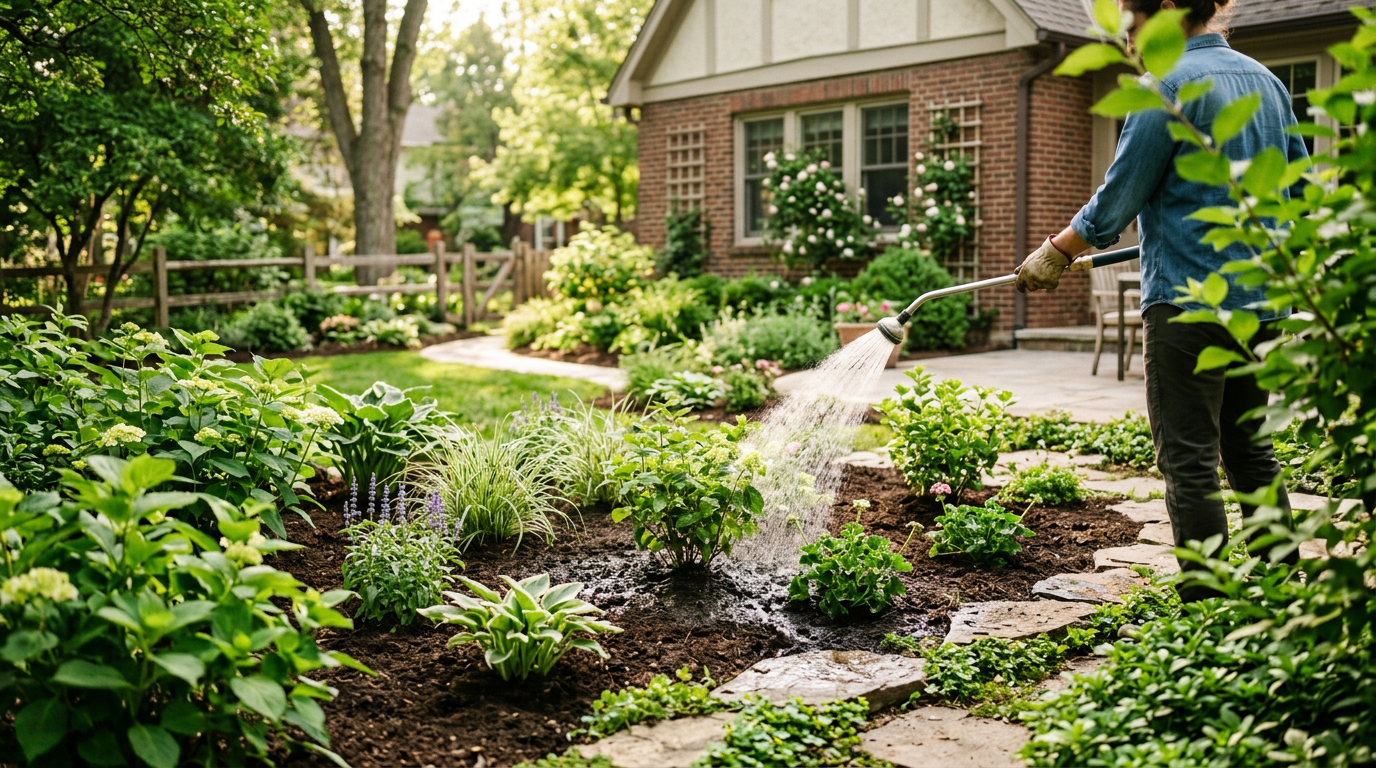
You did it. You went to the nursery, filled a cart with beautiful plants, and spent the weekend digging, amending, and arranging your new garden additions. Now comes the hard part: keeping them alive.
The number one question we get is, "How often do I water these new guys?" The internet is full of vague advice like "water regularly" or "keep moist." What does that even mean? It’s frustrating, and it’s how people end up with a collection of expensive, crispy-brown twigs.
Let's cut through the noise. We're going to give you a simple, effective watering strategy that works for everything from tiny annuals to sizable trees. This is how you protect your investment and get the lush, thriving landscape you envisioned.
The Golden Rule: It's About the Soil, Not a Schedule
Forget what you've heard about watering every Monday, Wednesday, and Friday. Plants don't own calendars. The single most important skill you can learn is how to check your soil moisture. We call it the "finger test," and it's dead simple.
Here's how to do it: Stick your index finger about two inches into the soil near the base of the new plant.
- Is the soil dry at your fingertip? It's time to water.
- Is the soil cool and moist? Hold off. Check again tomorrow.
That's it. That's the secret. Factors like sun, wind, humidity, and soil type change daily, making a rigid schedule useless. The finger test tells you what your plant actually needs, right now.
Your First Two Weeks: The "Babying" Phase
When you move a plant from its cozy nursery pot into the ground, you shock it. The fine root hairs that absorb most of the water are inevitably damaged. This is called transplant shock. Your job for the first 1-2 weeks is to make this transition as stress-free as possible.
During this period, you will water more frequently than you will later. The goal is to keep the root ball consistently moist, but not waterlogged. For most new plants (perennials, annuals, small shrubs), this means watering every day or every other day.
- Check the soil daily. Don't assume it needs water. Use the finger test.
- Hot, windy, or sunny weather? You'll almost certainly need to water daily.
- Cool, cloudy, or rainy weather? You might be able to skip a day.
The key is to not let the original root ball dry out completely. If it does, the already-stressed roots can't rehydrate, and the plant will wilt and die, fast. I nearly lost a beautiful 'Hot Papaya' Coneflower last summer by assuming a brief shower was enough a few days after planting. It wasn't. The root ball was bone dry an inch below the surface, and it took a week of intensive care to bring it back.
The "Tough Love" Phase: Establishing Deep Roots
After about two weeks, your plant has started to recover and send new roots out into the surrounding soil. Now it's time to change your watering strategy. Your new goal is to encourage deep, resilient roots, and you don't do that with little daily sips.
You're going to switch to deep, infrequent watering.
This means applying water slowly and for a longer period, but only 2-3 times per week. You want the water to penetrate at least 6-8 inches into the soil. This encourages roots to grow downward in search of moisture, creating a stronger, more drought-tolerant plant that won't collapse during a heatwave.
A general rule of thumb for established gardens is one inch of water per week. For new plants in this phase, you might need a bit more, especially in sandy soil or hot climates. How do you measure an inch of water? Place a few empty tuna cans (they're about an inch deep) in the area you're watering. When the cans are full, you're done.
For this, a soaker hose is your absolute best friend. Unlike a sprinkler, which loses up to 50% of its water to evaporation, a soaker hose delivers water directly to the soil. We love the Melnor Flat Soaker Hose (around $20 for 50 feet) because it's easy to snake around plants and delivers water evenly.
How Plant Type Changes the Game
Not all plants are created equal. Your watering strategy needs to adapt to what you've planted.
-
Annuals & Vegetables: These typically have shallower root systems and need more consistent moisture. For your new veggie patch, this means you'll likely stick with the finger test and water every 2-3 days all season long. Check out our guide on how to start a vegetable garden for more tips.
-
Perennials: Once established, many perennials are quite tough. After the initial 2-week babying phase, you can confidently switch to deep watering 2-3 times a week, tapering off as the season progresses. By their second year, most perennials for full sun will only need watering during extended dry spells.
-
Shrubs & Trees: These are your biggest investments. They need deep watering to establish their extensive root systems. For a new 5-gallon shrub, expect to give it a slow, deep soak (5-10 gallons of water) 2-3 times a week for the first few months. For newly planted fast growing privacy trees, the rule is about 10 gallons of water per inch of trunk diameter, applied slowly around the root zone.
Essential Tools & The Magic of Mulch
Having the right gear makes the job easier and more effective.
- A Good Hose & Nozzle: A quality spray nozzle with a "shower" setting is essential for hand-watering without blasting soil away.
- Soaker Hoses: As mentioned, these are king for efficiency. Lay them out at the beginning of the season and you're set.
- Watering Can: For targeted watering of just one or two new plants, a sturdy 2-gallon can is perfect. We're partial to the classic Behrens 2.5 Gallon Steel Watering Can (about $40) because it'll outlive us all.
- Mulch: This is not optional. A 2-3 inch layer of organic mulch (like shredded bark or pine straw) is the single best thing you can do for your new plants after watering. According to the University of New Hampshire Extension, a proper layer of mulch can reduce water loss from the soil surface by up to 70%. (Source: https://extension.unh.edu/resource/mulching-trees-and-shrubs-fact-sheet) It also suppresses weeds and keeps soil temperatures stable.
Overwatering vs. Underwatering: Reading the Signs
It can be tricky because, confusingly, the primary symptom is the same: wilting.
- An underwatered plant wilts because its cells lose turgor. The leaves will feel dry and crispy. The soil will be dry (use the finger test!).
- An overwatered plant wilts because its roots are drowning. They can't absorb oxygen, so they shut down and rot, unable to send water up to the leaves. The leaves will feel soft and limp, and often turn yellow. The soil will be soggy.
This is why you cannot water on a schedule. You must check the soil first. When in doubt, it's usually better to be a day late with water than a day early.
Watering new plants isn't black magic. It's about paying attention for the first few weeks and then setting them up for long-term success with deep, infrequent drinks. Follow these steps, trust the finger test, and you'll be enjoying your new landscape for years to come.
Frequently asked
How long should I water a new tree?+
For a newly planted tree, a good rule of thumb is to apply 10 gallons of water for every inch of trunk diameter. Use a slow-drip hose or a 5-gallon bucket with a hole drilled in it to ensure the water soaks in deep rather than running off.
Is it better to water new plants in the morning or evening?+
Early morning is the best time to water. This allows the foliage to dry before nightfall, reducing the risk of fungal diseases. Watering in the heat of the day leads to high evaporation, while evening watering can leave leaves wet overnight, which invites problems like powdery mildew.
Can you overwater a new plant?+
Absolutely. Overwatering is one of the most common ways to kill a new plant. It suffocates the roots, leading to root rot. Symptoms include yellowing leaves and wilting, even when the soil is wet. Always check soil moisture with your finger before adding more water.
Should I water new plants if it rains?+
It depends. A light, brief shower may only wet the surface and not reach the root ball. A slow, soaking rain for an hour might be enough. The only way to know for sure is to use the finger test. Check the soil 2 inches deep after the rain stops.