
The Best Shade Perennials for Low-Maintenance Gardens
Stop seeing shade as a problem. We’re sharing our battle-tested list of the best shade perennials that deliver massive color, texture, and interest with minimal fuss.
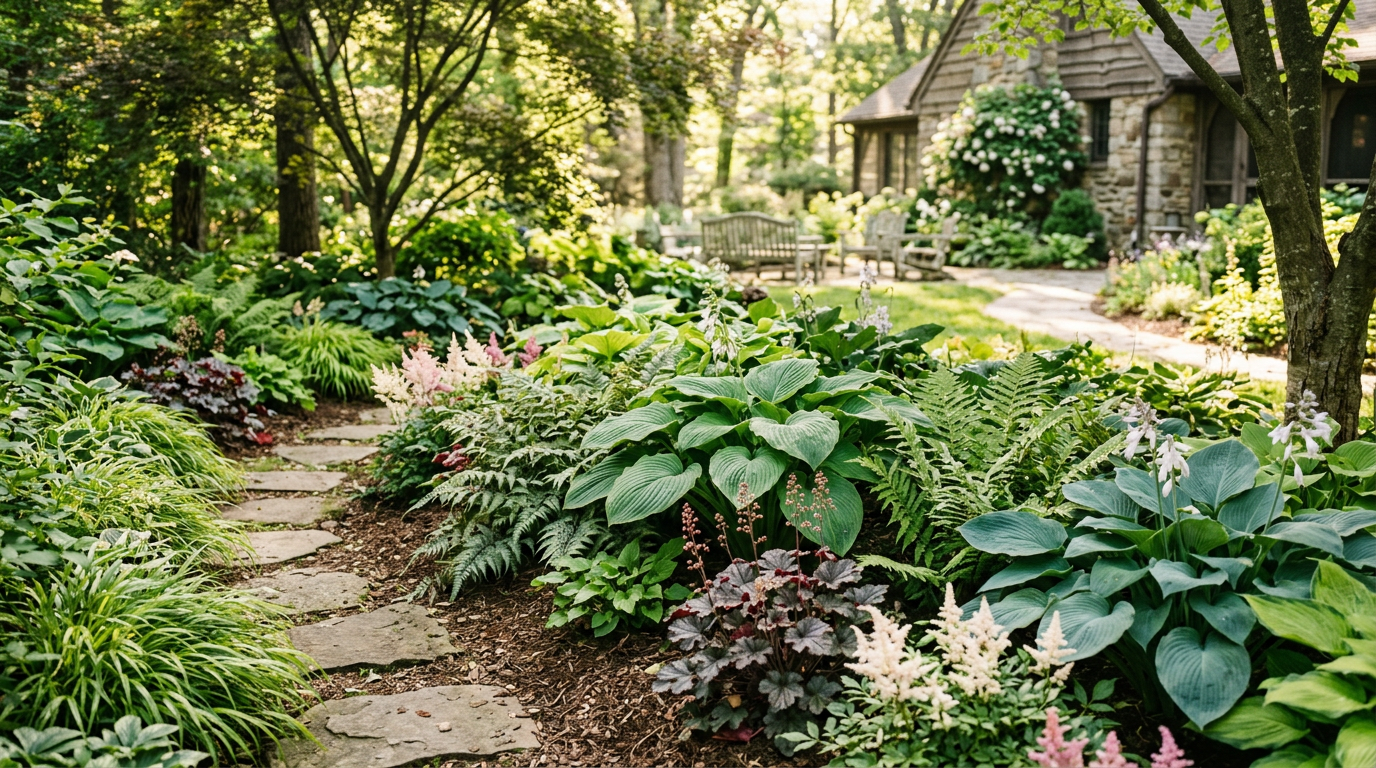
That dark corner of your yard under the big maple tree. The north-facing side of your house where the sun don't shine. The space behind the garage. We all have them—spots where grass gives up and weeds throw a party. The common thinking is that these spots are garden graveyards.
We're here to tell you that's dead wrong. Shade isn't a curse; it's an opportunity. It's a chance to create a lush, cool, and inviting space that's lower maintenance and often more texturally interesting than a full-sun bed. The secret? Choosing the right plants. Specifically, the best shade perennials.
Perennials are the workhorses of the garden. You plant them once, and they come back year after year, getting bigger and better over time. Unlike annuals, which you have to replant (and re-buy) every spring, perennials are a long-term investment in your landscape. This is the core of the Dirt Cheap Genius philosophy: do it right once, and enjoy the rewards for years.
Why Perennials Beat Annuals for Shade
Let's be blunt: gardening in the shade can be tricky at first. The plants that thrive there are often slower to establish. If you plant shade-loving annuals like impatiens or begonias, you're on a treadmill of buying and planting every single year. It's a recurring cost and a recurring chore.
Perennials, on the other hand, are the epitome of 'set it and (mostly) forget it.' Once they get their roots down, they're self-sufficient superstars.
- Cost-Effective: Buy a one-quart Hosta for $12. In three years, it's big enough to be divided into three separate plants. You just made two free plants. Try that with a flat of impatiens.
- Less Work: No annual replanting. The biggest job is a quick cleanup in spring or fall. Their established root systems also make them more resilient to drought and heat waves than shallow-rooted annuals.
- Soil Improvement: As perennials grow, their root systems help improve soil structure. When their leaves drop in the fall, they create a natural mulch that enriches the soil. They are active participants in building a better garden.
First, Understand Your Shade: It's Not All the Same
Before you buy a single plant, you have to play detective. 'Shade' is not a monolith. The success of your shade garden depends entirely on matching the plant to the specific light conditions. Go outside with a notepad at 9 am, 12 pm, and 3 pm and see what the sun is doing.
- Full Shade: This is the real deal. An area that gets less than 3 hours of direct sunlight per day, often with indirect or filtered light the rest of the time. This is the north side of a building or under a dense evergreen.
- Partial Shade (or Part Sun): These terms are often used interchangeably. This means the area gets a solid 3 to 6 hours of direct sun each day. Crucially, morning sun is much gentler than scorching afternoon sun. Many 'part shade' plants love morning sun and need protection from the afternoon heat.
- Dappled Shade: This is the magical, shifting light you find under a high-canopy deciduous tree (like a Honey Locust or an Oak). The light is constantly moving and filtered. It’s the ideal condition for a huge range of plants.
Knowing your type of shade is the difference between a plant that thrives and one that just... survives. Or dies. Don't waste money by guessing.
Our Top Picks: The Unkillable Shade Perennials (Almost)
We've trialed, killed, and celebrated hundreds of plants. This is our go-to list for reliable, beautiful, and readily available shade perennials that deliver the goods.
The Hosta Clan: Kings of Foliage
If you can only plant one thing, plant a Hosta. No other perennial offers such a range of sizes, colors, and textures. You can create an entire garden just with Hostas. They die back to the ground in winter and emerge fresh each spring.
- For big impact: 'Sum and Substance'. It has enormous, chartreuse leaves that can reach 2 feet across. A mature clump can be 6 feet wide. It’s a traffic-stopper and surprisingly tolerant of some sun.
- For blue tones: 'Halcyon'. A medium-sized plant with spear-shaped, intensely blue-gray leaves. The color holds well all season. It’s a classic for a reason.
- For variegation: 'Patriot'. Features deep green leaves with a crisp, wide, white margin. Brightens up any dark corner.
- Pro Tip: Slugs love Hostas. If you have a slug problem, choose thicker-leaved varieties (often called 'high substance') like 'Sum and Substance' or 'Blue Angel', as they are more resistant.
Astilbe: The Feather Dusters of Joy
When you need a splash of color and a soft, feathery texture, you need Astilbe. Their fern-like foliage is attractive on its own, but the real show is the plume-like flowers that rise above it in early to mid-summer. Their one demand? Consistent moisture. Do not let them dry out.
- Deep Red: 'Fanal'. A classic with deep crimson plumes and dark, bronze-tinted foliage.
- Pure White: 'Deutschland'. Provides bright white flowers that practically glow in the shade.
- Pretty in Pink: 'Visions in Pink'. A robust variety with dense, lilac-pink plumes that's a bit more drought-tolerant than others.
Heuchera (Coral Bells): The Color Bomb
If you think shade gardens are just green, you haven't met Heuchera. These plants are grown almost exclusively for their stunning, often ruffled, foliage that comes in every color imaginable—from lime green to deep purple-black and fiery orange.
- Lime Green: 'Citronelle'. Incredibly bright yellow-green leaves. Plant this where you need a 'lightbulb' in a dark spot.
- Deep Purple/Black: 'Obsidian'. The standard for near-black foliage. It holds its dark, glossy color all season. Stunning next to something chartreuse.
- Variegated: 'Caramel'. Features lovely honey-apricot colored leaves. It's a tough plant that can handle more heat and humidity than others.
Ferns: The All-Stars of Texture
Nothing says 'woodland shade garden' like a fern. They provide a delicate, ancient texture that contrasts beautifully with the bold leaves of Hostas and Heucheras.
- Japanese Painted Fern ('Pictum'): The supermodel of ferns. It has striking silvery fronds with hints of green and a deep burgundy stem. Not your average green fern.
- Ostrich Fern: For height and drama. These can get 3-4 feet tall in moist conditions and create a lush, tropical feel. They do spread, so give them room or use them as a groundcover in a larger area.
- Autumn Brilliance Fern: A semi-evergreen fern whose new fronds emerge in a coppery-red color, maturing to deep green. It provides multi-season interest.
Brunnera (Siberian Bugloss): The Silver Heart
This is a must-have. Specifically, the variety 'Jack Frost'. It has incredible heart-shaped leaves that look like they've been dusted with silver, with green veins showing through. In the spring, it sends up sprays of tiny, sky-blue flowers that look like forget-me-nots. It's deer-resistant and forms a perfect, tidy mound.
Hellebore (Lenten Rose): The Winter Warrior
Just when you think winter will never end, Hellebores push up through the cold soil (or even snow) to bloom. Their nodding, cup-shaped flowers appear in late winter and early spring, lasting for months. The foliage is evergreen and leathery, providing year-round presence. They are tough, deer-proof, and incredibly long-lived.
Planting & Care: Don't Just Dig and Pray
Unlike your sun-loving tomatoes in your vegetable garden, shade plants have specific needs. Get the planting right, and you're golden.
Soil is Everything: Most shade perennials evolved on a forest floor, a place with soil rich in decomposed leaves and organic matter. Your compacted clay soil behind the garage is not that. You MUST amend your soil. We’re not asking, we’re telling. Dig in a 2-4 inch layer of compost before planting. For a 10x10 foot area, this means about 5-6 bags of something like Black Kow Composted Cow Manure, which runs about $7 a bag. It's the best $42 you'll ever spend on your garden.
We learned the hard way that 'drought tolerant' doesn't mean 'drought proof' in the first year. We lost a whole row of expensive 'Caramel' Heucheras one hot July because we got lazy with the hose a month after planting. That first season is critical. Water deeply once or twice a week (if it doesn't rain) to encourage deep root growth.
Here’s a number to remember: According to the University of Georgia Extension, amending heavy clay soil with just 2 inches of compost can increase its water-holding capacity by over 50%. This is a game-changer for thirsty shade plants like Astilbe and reduces your watering chores. (Source: https://extension.uga.edu/publications/detail.html?number=C853)
Putting It All Together: Shade Garden Design 101
A great shade garden uses the principles of design to look intentional and beautiful, not like a random collection of plants.
- Thriller, Filler, Spiller: This classic container formula works for garden beds too. Use a tall plant as a 'thriller' (like an Ostrich Fern), mounding plants as a 'filler' (like Hosta and Brunnera), and a low-growing groundcover as a 'spiller' (like Lamium or Ajuga).
- Foliage First: Choose plants for their leaves. Flowers are a fleeting bonus. Combine the bold leaves of a Hosta, the fine texture of a Fern, and the lacy foliage of an Astilbe. This contrast is what creates visual interest all season long.
- Use Light Colors: In deep shade, dark purple and deep green foliage can disappear. Use plants with white, silver, or chartreuse leaves to pop and brighten the space. Think 'Patriot' Hosta, 'Jack Frost' Brunnera, and 'Citronelle' Heuchera. Many great shade-loving native plants for pollinators also fit this bill, like the silvery leaves of native Wild Ginger.
Stop looking at that shady spot as a problem. It's a blank canvas waiting for the right plants. Armed with this list and a few bags of compost, you can create a low-maintenance, high-impact garden that will be the envy of your sun-scorched neighbors.
Frequently asked
What perennial thrives in the deepest shade?+
Hosta is the king of deep shade, but also consider native Wild Ginger (Asarum canadense), Japanese Forest Grass, and many ferns. These plants are adapted to low-light forest floor conditions and prioritize foliage over flowers, providing texture and green color where little else will grow.
What flowers bloom best in the shade?+
For blooms, look to Astilbe for colorful plumes, Bleeding Heart for unique flowers, and Hellebores for very early spring color. Brunnera also offers sprays of tiny blue flowers. Most shade flowers bloom in spring before tree canopies fully leaf out, taking advantage of the available light.
What is the most low-maintenance shade perennial?+
Hosta is arguably the most low-maintenance. Once established, it requires little more than occasional watering during droughts and a yearly cleanup of old foliage. Many varieties are also incredibly long-lived and resistant to pests, especially newer slug-resistant cultivars like 'Sum and Substance'.
Can you have a pollinator garden in the shade?+
Absolutely. While full-sun gardens offer more options, many shade-tolerant native plants are fantastic for pollinators. Look for woodland species like Jacob's Ladder, Virginia Bluebells, and Foamflower. These plants provide crucial early-season nectar for bees and other insects.