
Modern Front Yard Landscaping Ideas for Max Curb Appeal
Stop staring at your sad lawn. We're breaking down modern front yard landscaping into simple, actionable ideas that add serious curb appeal without the high-end designer price tag.
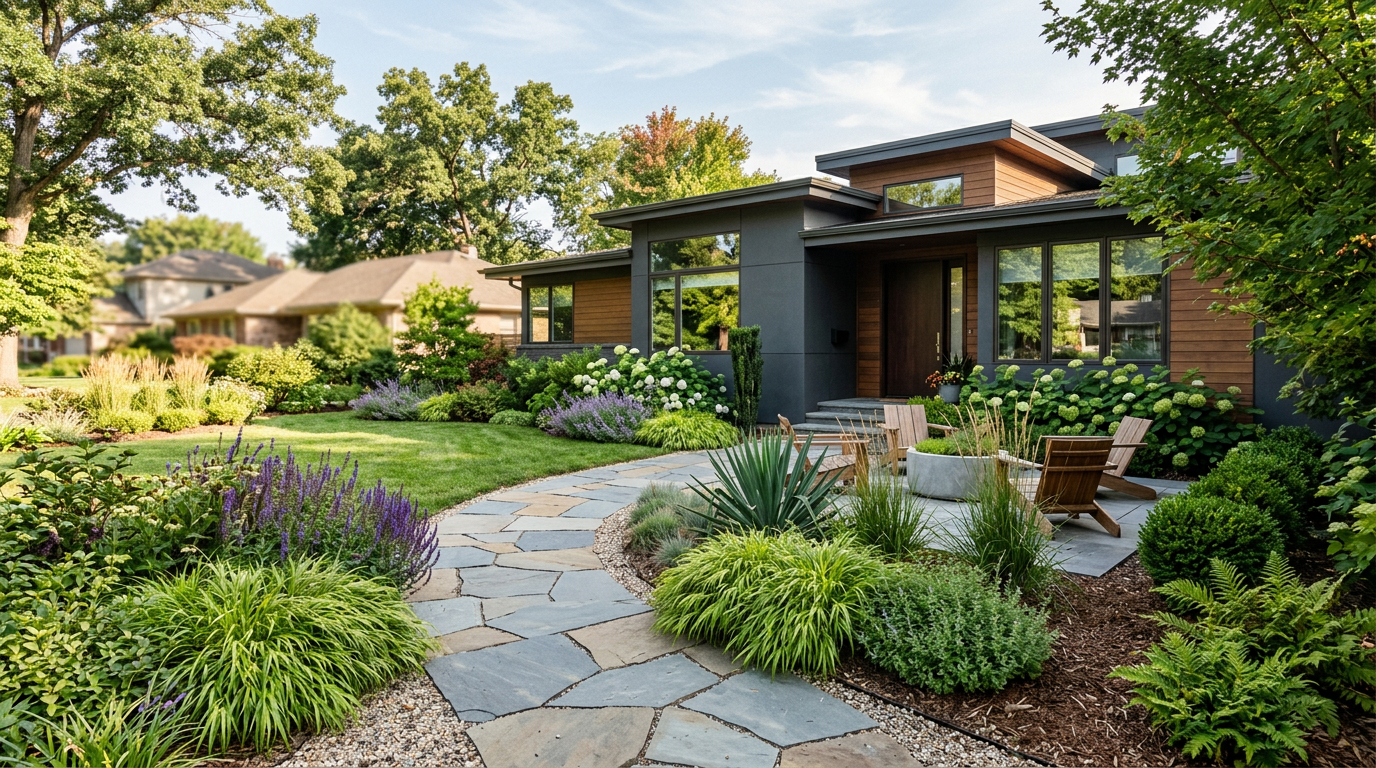
Let's be blunt: when people hear "modern landscaping," they often see dollar signs and imagine some sterile, uninviting space that looks more like an art gallery entrance than a home. That's gatekeeping nonsense. At its core, modern design is about making intentional choices that create a clean, uncluttered, and highly functional outdoor space. It's about curb appeal that looks sharp, sophisticated, and, best of all, is often way easier to maintain than a traditional, fussy English garden.
We're here to demystify the process. You don't need a degree in architecture to pull this off. You just need a plan and the confidence to ditch the 'more is more' mindset. We’ll walk you through the core principles, from the hardscape foundation to the plant-and-forget-it foliage that makes it all work.
First, What Exactly Is Modern Landscaping?
Before you start digging, you need to know the rules of the game. Modern landscape design isn't a free-for-all. It's guided by a few key principles:
- Clean Lines & Geometric Shapes: This is the big one. Think straight lines, right angles, and clear, defined spaces. Walkways are linear, not meandering. Garden beds are rectangular or square, not kidney-bean shaped. Patios are grids. The structure of the yard is king.
- Limited Material Palette: Instead of using ten different types of stone, a modern design might use just two or three: smooth concrete, dark gravel, and warm cedar, for example. Repetition creates a sense of calm and cohesion.
- Emphasis on Form & Texture: With a simpler color palette, the texture of materials and the shape of plants become the main event. The rough texture of a gravel path contrasts with the smooth face of a concrete wall. The feathery movement of ornamental grass contrasts with the rigid form of a boxwood hedge.
- Less is More: Ditch the clutter. Every element, from planters to plants, should feel intentional. This isn't about cramming 30 varieties of flowers into one bed. It's about the powerful statement made by a single, beautiful Japanese Maple or a massive drift of a single type of grass.
The Foundation: Hardscaping with Clean Lines
Your hardscaping—the pavers, walkways, walls, and patios—is the skeleton of your modern yard. Get this right, and the rest is easy. Get it wrong, and you'll always be fighting it.
For walkways and patios, think big. Forget small, busy-looking 4x8 brick pavers. The modern choice is large format slabs. We're big fans of Techo-Bloc's Blu 60 Smooth pavers. They come in large sizes (like 13"x26" or 26"x26") and create a sleek, expensive-looking surface for around $8-$12 per square foot. Poured-in-place concrete, scored into a large grid pattern, is another fantastic, durable option.
For paths through garden beds, consider large rectangular concrete steppers surrounded by dark Mexican Beach Pebbles or black star gravel. This creates a high-contrast, graphic look that screams modern.
If you have a slope, retaining walls become a design feature. A gabion wall—a wire cage filled with uniform rock—is an industrial-chic look that adds incredible texture. For a smoother look, consider a wall made from smooth-faced concrete blocks or, for a higher-end project, board-formed concrete.
Plant Palettes: The Power of Mass Planting
Here's where most people get overwhelmed. The secret to modern planting isn't knowing a million plant names; it's knowing how to use just a few of them effectively. The key is mass planting.
Instead of one of this and one of that, you plant large groups, or 'drifts,' of the same plant. This creates a much bigger visual impact and a serene, unified feel. It also happens to be a core tenet of Low Maintenance Backyard Ideas That Actually Work, because caring for one large block of plants is far simpler than tending to 20 needy individuals.
Our go-to plants for this approach are:
- Ornamental Grasses: They are the undisputed champions of modern gardens. They add movement, texture, and year-round interest. 'Karl Foerster' Feather Reed Grass is a workhorse—upright, tidy, and around $20 for a 1-gallon pot. Blue Fescue creates beautiful low mounds of silvery-blue, and Mexican Feather Grass adds soft, ethereal movement.
- Structural Plants: To contrast with the softness of grasses, you need plants with strong shapes. Boxwoods pruned into tight spheres or cubes are a classic. Architectural succulents like Agave and Yucca provide dramatic, spiky forms that thrive in sunny, dry spots.
- Groundcover: Instead of mulch in some areas, use a mass planting of a low-growing groundcover like Creeping Thyme or Japanese Sweet Flag for a living carpet of green.
We recently finished a project where we ripped out a fussy, overgrown collection of 20 different perennials. We replaced it with three massive drifts of Karl Foerster grass, a simple concrete paver walkway, and a single 'Bloodgood' Japanese Maple. The homeowner was shocked at how much bigger and more sophisticated the yard looked, and their weekend maintenance went from 3 hours to about 15 minutes.
Materials Matter: Metal, Wood, and Stone
Your choice of non-plant materials will make or break the modern look.
-
Metal: Corten steel, also known as weathering steel, is the iconic material for modern planters, edging, and retaining walls. It develops a stable, rust-like patina that is absolutely gorgeous against green foliage. It's not cheap—a simple 24"x24" Corten steel planter from a brand like Veradek can run you $150-$200—but the impact is undeniable. For a more budget-friendly option, powder-coated aluminum edging in black provides a razor-sharp, clean line between lawn and garden bed.
-
Wood: For fences or deck accents, the key is horizontal lines. A horizontal slat fence made from a rich wood like Ipe or clear Cedar creates a sense of width and privacy while looking incredibly chic. It's the perfect backdrop for your plantings.
-
Gravel & Decomposed Granite (DG): Using stone as groundcover is a low-water, zero-maintenance move that fits perfectly with the modern aesthetic. It's an excellent design element for small spaces, a concept we explore more in our guide to Small Backyard Design Ideas That Don't Suck (or Cost a Ton). A clean gravel path or a DG patio space provides texture and a clean surface. Just be sure to install high-quality landscape fabric underneath to stop weeds.
The Numbers: Good Design is a Good Investment
If you're still on the fence, let's talk numbers. Investing in your front yard landscaping isn't just about making your house look good; it's one of the highest-ROI home improvements you can make. According to the National Association of Realtors' 2023 Remodeling Impact Report, a landscape upgrade can recover 100% of its cost at resale. Furthermore, the report notes that curb appeal is a major factor for buyers, with 92% of realtors recommending sellers improve their curb appeal before listing. A modern, low-maintenance design is particularly appealing to today's busy homebuyers who want a move-in ready home without a long list of weekend chores. (Source: https://www.nar.realtor/research-and-statistics/research-reports/remodeling-impact-report)
Don't Forget the Details: Lighting & Accessories
Finally, it's the finishing touches that elevate a design from 'good' to 'great'.
First, house numbers. Ditch the peeling, curly-cued brass numbers from 1988. This is the cheapest, fastest modern upgrade you can make. Buy a set of large (5-8 inch), minimalist, sans-serif numbers in black or brushed nickel. A set from a company like Modern House Numbers will cost you about $25-$40 per digit and installs in 30 minutes.
Second, lighting. Bad lighting will ruin a great design. Modern landscape lighting is about subtlety and effect. Instead of planting runway lights along your path, use light to highlight features. A single uplight on a specimen tree. A wash of light across a textured wall. LED hardscape lights tucked under stair treads or retaining wall caps. We cover this extensively in our post on Landscape Lighting Ideas That Don't Look Cheap. For a reliable starting point, look at products from VOLT Lighting. Their simple path lights and spotlights are pro-quality and built to last.
By focusing on these core elements—strong hardscaping, mass plantings, a controlled material palette, and intentional details—you can create a stunning modern front yard that will turn heads and give you back your weekends.
Frequently asked
What is the main principle of modern landscaping?+
The core idea is 'less is more.' It focuses on clean, geometric lines, a structured layout, and a limited palette of plants and materials. Simplicity, form, and texture are valued over ornate details and a chaotic mix of variety. Every element feels intentional.
How can I make my front yard look modern on a budget?+
Start with high-impact, low-cost changes. Replace house numbers with a modern font, paint your front door a bold color, and create crisp edges on your lawn and garden beds. Using affordable dark mulch or angular gravel can also create a clean, modern groundcover look.
What are the best plants for a modern front yard?+
Ornamental grasses (like Karl Foerster), architectural succulents (like agave or yucca), and structural evergreens (like boxwood shaped into cubes) are excellent choices. The key is to plant them in large, uniform groups or 'masses' for the best effect, rather than mixing many different species.
Is a modern front yard hard to maintain?+
No, it's typically the opposite. By using hardy perennials, mass plantings that choke out weeds, and hardscape features like gravel beds instead of lawn, modern designs often require significantly less mowing, watering, and general upkeep than traditional gardens.
What's the difference between modern and contemporary landscape design?+
While often used interchangeably, 'Modern' typically refers to the specific design style of the mid-20th century (think sharp lines, minimalism). 'Contemporary' is more fluid and refers to what's popular now, which often includes modern elements but can also incorporate more curves and sustainable practices.