
Front Yard Landscaping Ideas for Ranch Homes (2024)
Ranch homes have a unique charm and a unique challenge: their long, low profile. Here are the pro-level front yard landscaping ideas that actually work for them.
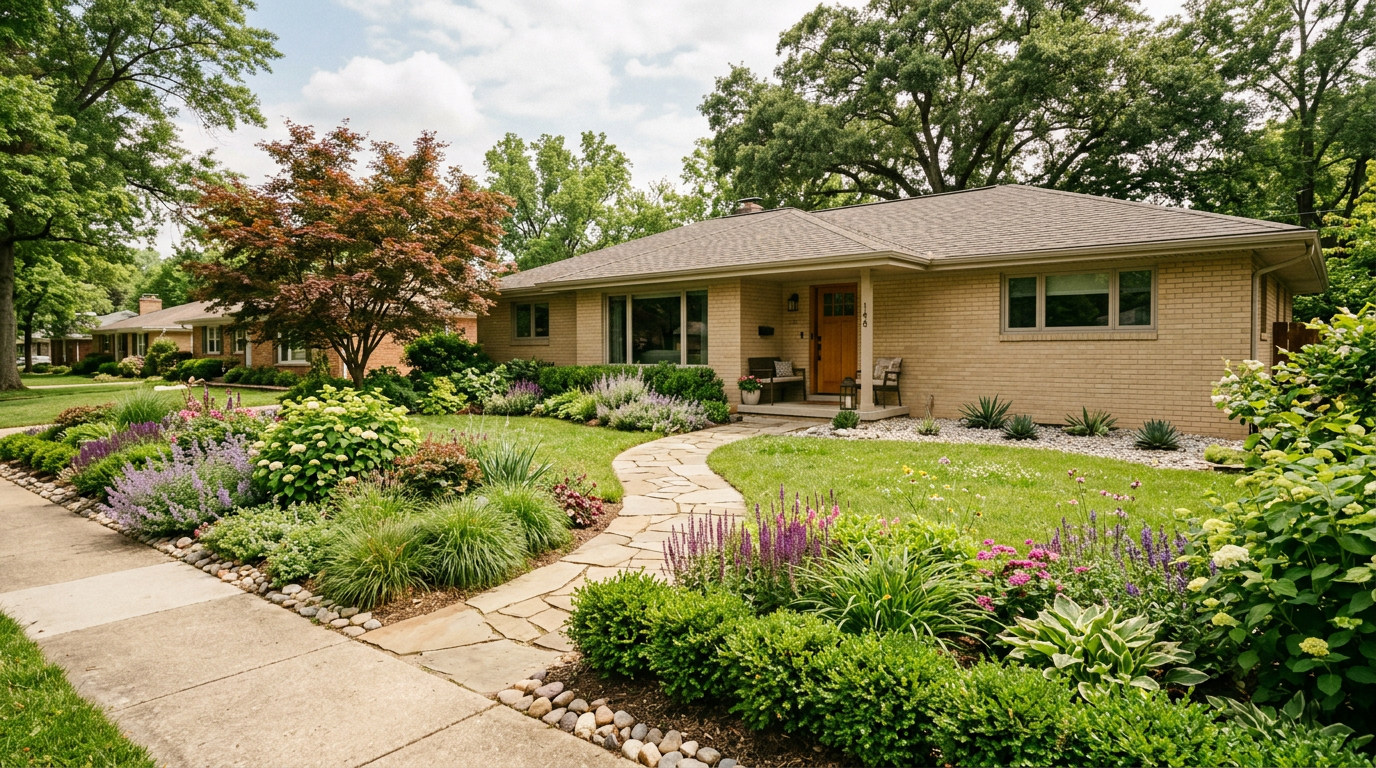
Why Your Ranch Home's Yard Feels... Off
Let's be direct. You love your ranch home, but the front yard feels like a bowling alley. It's long, it's flat, and every attempt at planting just seems to emphasize how low-slung the whole property is. This is the core challenge of landscaping a classic American ranch: its powerful horizontal lines.
Most traditional landscaping advice is built for two-story colonials. That advice will fail you here. Planting two sad little shrubs on either side of the front door just looks goofy. A straight, skinny concrete path from the driveway makes your house look even longer and less inviting.
We're not here to gatekeep the secrets. The trick isn't to fight the ranch's horizontal nature, but to complement it with intentional verticality, depth, and curves. We're going to show you how to turn that long facade into a stunning canvas for some serious curb appeal.
1. Create Vertical Interest (Please)
Your number one job is to add height. Without it, the house will always feel squat. You need to draw the eye upward. But this doesn't mean planting a massive Blue Spruce that will swallow your house in 15 years.
Think strategically. Use slender, columnar trees and shrubs that provide height without massive width.
- Columnar Trees/Shrubs: 'Sky Pencil' Holly is a classic, reaching 8-10 feet tall but only 2-3 feet wide. For something a bit softer, consider the 'Standing Ovation' Saskatoon Berry bush or a few well-placed Italian Cypress trees in warmer climates (zones 7-10).
- Ornamental Grasses: Don't sleep on grasses. Karl Foerster feather reed grass is a workhorse, shooting up to 5 feet tall with a beautiful wheat-like plume. It provides height, texture, and movement.
- Hardscaping: A well-placed arbor over a walkway or a tall, modern metal trellis against a blank brick wall can provide instant verticality. We recently saw a client use a trellis with a climbing 'New Dawn' rose that completely transformed a boring garage wall.
2. Ditch the Skinny Sidewalk
A three-foot-wide concrete path running in a straight line from the driveway to your front door is a curb appeal killer. It feels like an afterthought. Ranch homes have the yard space to support something more substantial and inviting.
Our rule: your main walkway to the front door should be a minimum of 4 feet wide, and ideally 5 feet. This allows two people to walk side-by-side comfortably.
Instead of a straight line, introduce a gentle, sweeping curve. This does two things: it makes the journey to the door feel more like a grand reveal, and it creates a large, deep planting bed between the walkway and the house. This is prime real estate for the layered look we'll talk about next.
For materials, pavers are your best friend. They look infinitely better than poured concrete and offer tons of design flexibility. Something like the Belgard Catalina Grana paver offers a clean, modern look and costs around $6-$9 per square foot for the material. If you're up for a weekend project, you can even tackle it yourself. Check out our DIY Paver Patio Step by Step guide—the principles are exactly the same for a walkway.
3. Master the Art of Layering
Now that you have a deep planting bed thanks to your new, wider walkway, you can create the layered look that professional designers use. This is about creating depth by placing plants in rows based on their mature height.
Think of it in 3-4 layers:
- Back Layer (Against the House): This is where you put your tallest elements. Think climbing vines on a trellis, taller shrubs like a dappled willow, or the ornamental grasses we mentioned. This layer softens the hard lines of the house.
- Mid-Layer: This is for your medium-sized shrubs and perennials. Hydrangeas (a 'Limelight' Hydrangea is a stunner), boxwoods for structure, and perennials like Coneflower or Black-Eyed Susans work well here. Aim for plants in the 2-4 foot height range.
- Front Layer (Border): This is for your low-growing border plants. Catmint, hostas (in shady spots), creeping phlox, or low-mounding grasses like 'Elijah Blue' Fescue define the edge of the bed and provide a finished look.
- Groundcover ('Spiller'): Use plants like Creeping Thyme or 'Angelina' Sedum to spill over the edge of the walkway, softening the hard edge of the pavers.
This layering technique gives the yard a lush, full appearance that you can't get by just dotting plants around. It's a key strategy for low-maintenance backyard ideas too, as dense plantings help crowd out weeds.
4. Embrace Asymmetry
Many ranch homes, especially mid-century ones, are not symmetrical. The front door is often off-center, with a long wall of windows on one side and the garage on the other. Stop trying to force symmetry by putting identical plants on either side of the door. It won't work.
Instead, use visual weight to create balance. If you have a large garage on the right side, you need to create a significant landscape feature on the left to balance it out. This could be:
- A large, deep planting bed with a specimen tree (like a Japanese Maple).
- A cluster of 3-5 boulders of varying sizes.
- A decorative bench nestled into a garden nook.
We just finished a project on a 1960s brick ranch where the front door was pushed way to the left. We balanced the visual weight of the long brick wall and garage on the right by installing a large, circular paver patio area on the left, complete with a small water feature. It created a destination and made the whole composition feel intentional and balanced. If you're thinking about a project like this, it's worth understanding the costs involved. Check out our guide on how much landscape design costs for a realistic budget.
5. Light It Up
Don't let your hard work disappear at sunset. Proper landscape lighting is one of the most impactful upgrades you can make, and it's especially important for ranch homes.
Good lighting adds depth, drama, and security. Forget the cheap, solar-powered lollipop lights from the big box store. Invest in a quality low-voltage system. We're big fans of the VOLT All-Star Professional Kit, which gives you everything you need for around $500. It's a game-changer.
Here's where to focus your lights:
- Uplighting: Place one or two spotlights aimed up at the trunk of a feature tree. This creates a dramatic silhouette.
- Wall Washing: Use wide-angle flood lights to cast a soft, even glow across a long brick or stone facade, highlighting its texture.
- Path Lighting: Use path lights to illuminate your new, wide walkway. Place them on alternating sides, staggered about 8-10 feet apart, to avoid the 'runway' look.
Thoughtful lighting makes your home look just as good at 9 PM as it does at 9 AM. For more inspiration, browse our gallery of landscape lighting ideas that don't look cheap.
Investing in your front yard landscaping isn't just about making things pretty. According to research from Virginia Tech, a well-designed landscape can increase a home's perceived value by 5.5% to 12.7%. For a $400,000 home, that's an increase of $22,000 to over $50,000. That's a serious return on your investment of sweat equity and a few weekends.
Whether you're going for a clean, minimalist vibe with our modern front yard landscaping ideas or a lush, cottage-style garden, these principles for handling the unique shape of a ranch home will set you up for success.
Frequently asked
What is the best landscaping for a ranch style house?+
The best landscaping for a ranch house focuses on adding vertical height to balance its low profile. Use columnar trees, trellises, and layered planting beds with plants of varying heights. Wide, curving paths are also more effective than narrow, straight ones for adding depth and curb appeal.
How can I add curb appeal to my ranch house?+
To add curb appeal to a ranch, replace a narrow walkway with a wide, curved paver path. Create deep, layered garden beds against the foundation, and add vertical elements like a small ornamental tree or tall grasses. Good landscape lighting will highlight these features at night.
How do you landscape the front of a long house?+
For a long house, break up the facade with deep planting beds and varying heights. Use a curving walkway to add dimension. Instead of trying to create symmetry, balance the visual weight of architectural features (like a garage) with significant landscape elements (like a specimen tree or large boulder grouping) on the opposite side.
What kind of trees look good in front of a ranch house?+
Slender, upright trees that don't get too wide are ideal. Consider columnar varieties like 'Sky Pencil' Holly or 'Standing Ovation' Saskatoon Berry. Smaller ornamental trees like Japanese Maples or Dogwoods also work well, especially when placed away from the foundation to balance an asymmetrical facade.